How padel scoring works: points, games, sets and tie-break
Rules version: this article follows the FIP Rules of Padel, revision applying from 1 January 2026 (approved in Acapulco on 28 November 2025), which the Spanish federation (FEP) also publishes as its own rules of play. Published 7 October 2026 · last checked 7 October 2026. We re-read the FIP and FEP texts whenever they change and update this page; the sources are listed at the end.
The short answer: points in a game count 0, 15, 30, 40, then game. At 40-40 (deuce) the game is finished by the agreed method: advantage, Star Point or golden point. The first pair to win six games, two clear, wins the set; at 6-6 a tie-break decides it. A match is usually the best of three sets.
Padel scoring takes about five minutes to learn and one match to get used to. This page goes from the smallest unit, a point, up to the whole match, spends extra time on 40-40 because that is where beginners get stuck, and ends with a game played out point by point with the calls you would hear on court. Everything follows Rule 1 of the FIP Rules of Padel, the international rulebook, in its 2026 revision.
The count in 30 seconds
- A point is one rally. The pair that wins it moves one step up the ladder: 0, 15, 30, 40, game.
- A game is won by the pair that reaches four points, unless both reach three (40-40, “deuce”). Then the agreed deciding-point method applies.
- A set is won by the first pair with six games and a two-game lead. At 6-6 a tie-break decides the set, 7-6.
- A match is normally the best of three sets.
The serving pair’s score is always said first.
Points: 0, 15, 30, 40 and game
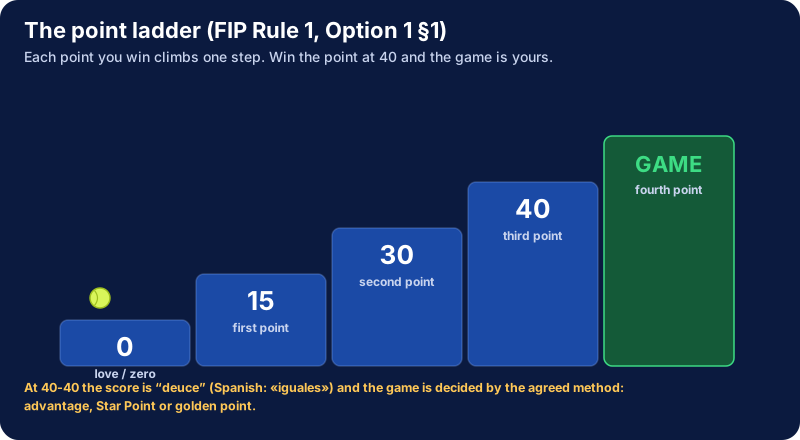
A game is won by climbing a short ladder. Each point you win moves your pair up one step:
| Points won | Called (English) | Called (Spanish) |
|---|---|---|
| 0 | love, or zero | cero |
| 1 | 15 | quince |
| 2 | 30 | treinta |
| 3 | 40 | cuarenta |
| 4 | game | juego |
Win the point when you are at 40 and the game is yours, provided the other pair is not also at 40. The steps are not 1, 2, 3, 4, so just learn the sequence; the FIP text itself describes it as “on the first point won ‘15’ will be called, on the second point won ‘30’, the third point ‘40’ and the fourth ‘game’” (Rule 1, Option 1 §1).
Both pairs climb their own ladder. When the pairs have won two points and one point, the score is 30-15 or 15-30 depending on who is serving; when both have won one point it is “15-all” (“15 iguales” in Spanish).
At 40-40: advantage, Star Point or golden point
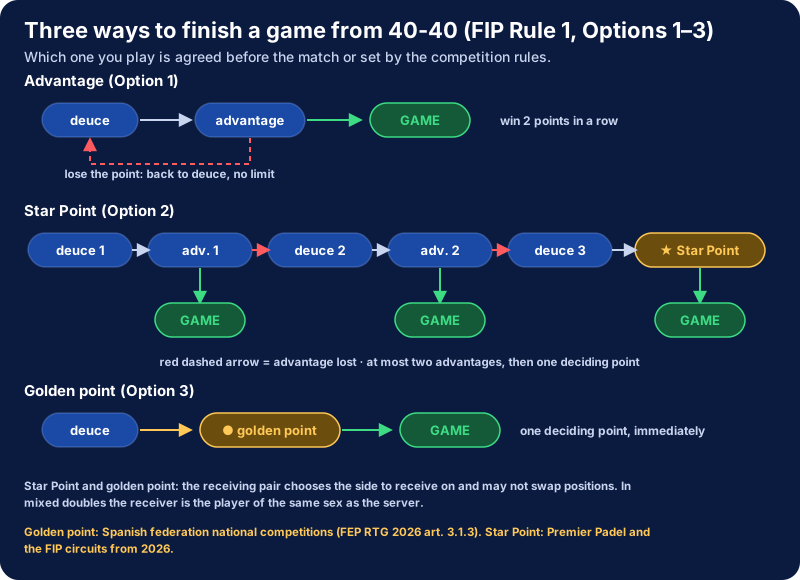
When both pairs reach 40 the score is “deuce” in English, “iguales” in Spanish. A single point no longer ends the game by default, so the rules need a way to break the tie. The 2026 rulebook lists three methods, as Options 1, 2 and 3 of Rule 1. None of them is the default: the competition rules, or the four players before the match, decide which one applies.
| Method | How it works | Who plays it in 2026 |
|---|---|---|
| Advantage (Option 1) | Win the next point for the advantage, then one more for the game. Lose it and you are back to deuce. No limit. | Most friendly matches; the traditional format |
| Star Point (Option 2, new in 2026) | Like advantage, but capped: at most two advantages, then one deciding point. | Premier Padel, the CUPRA FIP Tour, FIP Promises and FIP Beyond |
| Golden point (Option 3) | One deciding point at 40-40. The winner takes the game. | Spanish federation (FEP) national competitions; many amateur leagues |
Advantage
At deuce, the pair that wins the next point has the advantage. If they win the following point as well, they win the game; if they lose it, the score returns to deuce, “and so on until one pair of players has won the two consecutive points which are needed to win the game” (Option 1 §1). There is no limit on how many times this can repeat, which is why advantage games can run long.
Star Point
The Star Point works like advantage with a ceiling, and the calls carry numbers so that everyone knows where in the sequence they are: “deuce 1”, then “advantage 1”; if the advantage is lost, “deuce 2”, then “advantage 2”; if that is lost too, “deuce 3”, and a single deciding point, the Star Point, is played. Whoever wins it wins the game (Option 2 §1). In short: at most two advantages, then one point decides. The Star Point was added to the rulebook for 2026; the Star Point article covers where it is played and why it was introduced.
Golden point
At 40-40 one point is played and whoever wins it wins the game (Option 3 §2). There is no way back. This is the format of the Spanish federation’s national competitions in 2026 (FEP general technical regulations, article 3.1.3) and of many amateur leagues.
Who receives the deciding point
In both the golden point and the Star Point, the receiving pair chooses whether to receive from the right-hand or the left-hand side of the court, and the two receivers cannot swap positions for that point, so choosing the side effectively chooses who receives. In mixed doubles, the player of the same sex as the server receives (Option 2 §1–2, Option 3 §2–3).
Which one should you play?
The format decides. In a tournament, the organiser’s rules apply. In a friendly or at your club, agree on one before the first serve, so nobody argues over it at 40-40. If you want shorter games but find the golden point too brutal, the Star Point is the middle ground.
Games and the set: six games, two clear
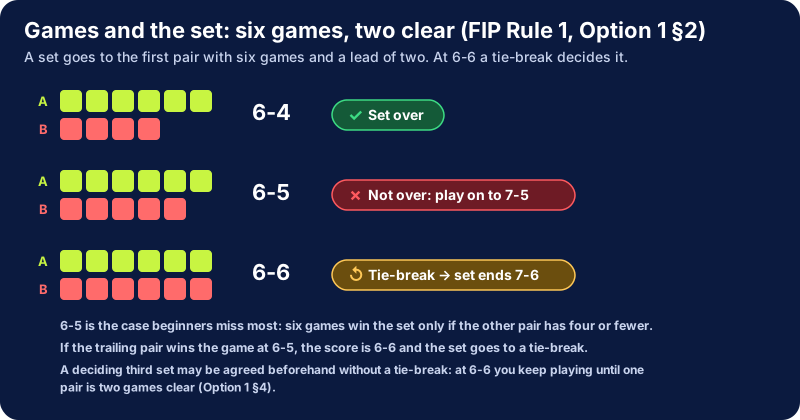
A set goes to “the first pair to win 6 games, always with a minimum advantage of 2” (Option 1 §2):
- 6-4: the set is over.
- 6-5: not over. “In the case of a tie at 5 games the players will have to play two more games, to win by 7-5.” If the leading pair wins the next game, it is 7-5 and the set is over; if the other pair wins it, the score is 6-6.
- 6-6: a tie-break decides the set.
The “two clear” part is the fact beginners miss most often. Six games are enough only if the opponents have four or fewer.
The tie-break at 6-6
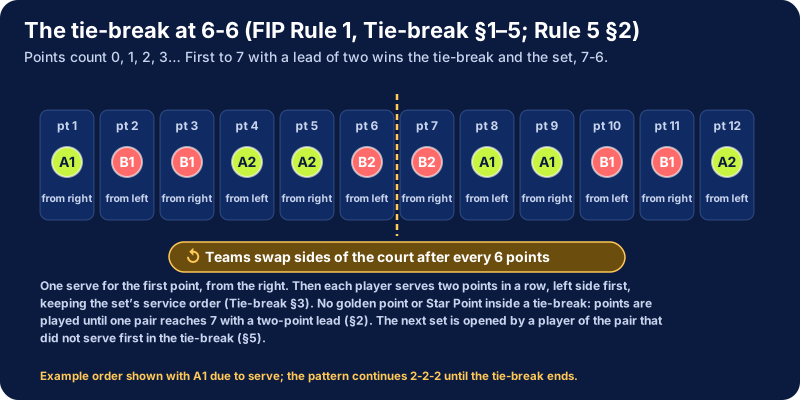
Points in a tie-break are counted “zero, 1, 2, 3, etc.” (Tie-break §1). The first pair to reach 7 points with a two-point lead wins the tie-break, the game and the set, which is recorded as 7-6; if necessary the tie-break “continues until this margin is obtained” (§2, §4). There is no golden point or Star Point inside a tie-break: points are simply played one after another.
The serve follows a fixed pattern (§3). The player whose turn it is to serve takes one point, from the right-hand side. The next two points are served by the opposing pair, keeping the set’s service order, starting from the left; after that every player serves two consecutive points until the tie-break ends. The pairs swap sides every six points (Rule 5 §2), and the following set is opened by a player of the pair that did not serve first in the tie-break (§5).
If you want the mechanics of who serves when in a normal game, the serve rules cover the service order and the 2026 changes to the serve itself.
The match: best of three sets
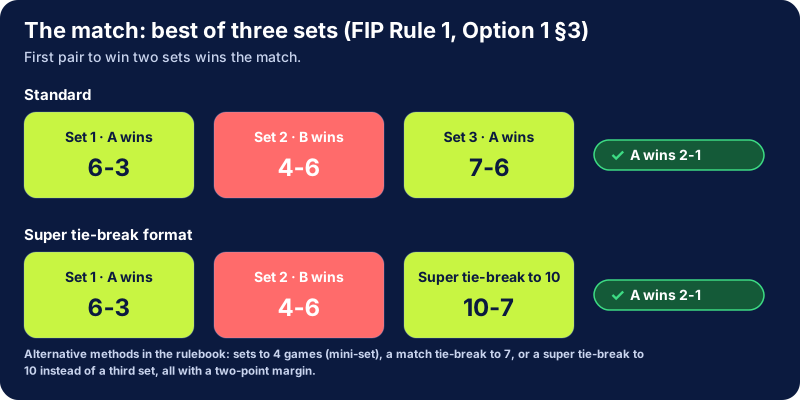
“The match is the best of three sets. Two out of three sets need to be won in order to win the match” (Option 1 §3). Each set follows the rules above, with a tie-break at 6-6.
The rulebook recognises three alternative formats, all requiring a two-point margin:
- Mini-sets to four games, with a tie-break at 4-4 (Alternative methods §1a).
- A match tie-break to 7 points instead of a third set, at one set all (§1b).
- A super tie-break to 10 points instead of a third set, at one set all (§1c). This is the one most clubs use when court time is short.
And one variation inside the standard format: at one set all, “and always previously established”, the third set may be played without a tie-break, so that at 6-6 you keep playing until one pair is two games clear (Option 1 §4). Playing every set without a tie-break is a club tradition, not a FIP format.
The deuce method and the match format are separate choices. You can play best of three with advantage, with golden point or with Star Point, and the same goes for a super tie-break. Agree both before you start.
Calling the score: the server’s score first
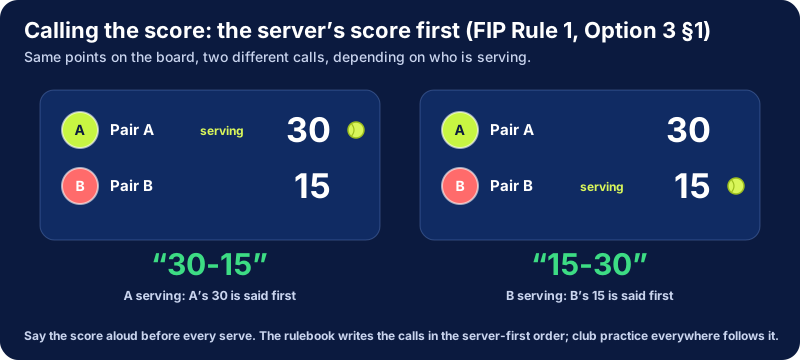
The rulebook writes the calls with the server’s score first: under the golden-point option it says “the score called is that of the server as follows” and then lists love, 15, 30, 40 (Option 3 §1), and club practice everywhere follows the same order. So “30-15” means the serving pair has 30 and the receiving pair has 15. With the same points on the board but the other pair serving, the call is “15-30”.
Saying the score aloud before every serve is a convention rather than a rule, but it prevents most arguments. It takes two seconds, and it gives everyone on court a chance to say “wait, I thought it was 15-all” before the point is played rather than after.
The calls you will hear, in the two languages of the FIP rulebook:
| English | Spanish |
|---|---|
| love, zero | cero |
| fifteen, thirty, forty | quince, treinta, cuarenta |
| fifteen-all, thirty-all | quince iguales, treinta iguales |
| deuce | iguales |
| advantage | ventaja |
| game | juego |
| set | set |
| match | partido |
| tie-break | tie-break, muerte súbita |
| golden point | punto de oro |
| Star Point | Star Point |
An example game, point by point
Pair A is serving. Both pairs start at 0.
| Point won by | Score called (A serving) | Why |
|---|---|---|
| A | 15-love | pair A climbs to 15 |
| B | 15-all | both pairs at 15 |
| A | 30-15 | pair A at 30, pair B at 15 |
| A | 40-15 | pair A one point from the game |
| B | 40-30 | pair B climbs to 30 |
| B | deuce | both at 40 |
From here the three methods part ways:
- Advantage. Pair A wins the next point: “advantage A”. Pair B wins: back to “deuce”. Pair A wins: “advantage A”. Pair A wins again: “game, A”. This could have gone on for as long as the pairs kept trading points.
- Star Point. The first deuce is “deuce 1”. Pair A wins: “advantage 1, A”. Pair B wins: “deuce 2”. Pair B wins again: “advantage 2, B”. Pair A wins: “deuce 3”, and the Star Point is announced. The receivers choose their side, one point is played, and whoever wins it wins the game.
- Golden point. At the first deuce the receivers choose their side and one point is played. Whoever wins it wins the game.
Whichever way the game ended, the pairs now swap service: pair B serves the next game, and the games count towards the set, 1-0 or 0-1. The pairs also swap sides after the first game and then after every odd game of the set (Rule 5 §1).
Sources
All rule statements on this page were checked against the official texts below on 7 October 2026.
- FIP, Rules of Padel, revision applying from 01.01.2026, Rule 1 “Score in a game” (Options 1 to 3, “Tie-break”, “Alternative score methods”) and Rule 5 “Changes of sides” (English): padelfip.com/…/FIP_Rules-of-Padel.pdf. Spanish original, Reglas del Pádel, Regla 1 “Puntuación” (Métodos 1 a 3, “Muerte súbita o tie-break”, “Métodos de puntuación alternativos”) and Regla 5: padelfip.com/…/FIP_Reglas-del-Padel.pdf. If the FIP link moves, we keep a reduced-size copy of the Spanish text as downloaded on 7 October 2026; the FIP site is the authoritative version. Note: the English text of Option 3 §2 says the golden point wins “the match”; the Spanish original says it wins the game (“se adjudica el juego”), which is the correct reading.
- FIP press release, 18 December 2025, “Between innovation and tradition: introducing the Star Point”: English · Spanish PDF. Which circuits use the Star Point from 2026.
- Federación Española de Pádel, Reglamento Técnico General 2026 (amendments approved on 13 March 2026), article 3.1.3, golden point in all national competitions: padelfederacion.es/…/RTG CD 13-3-26.pdf. The FEP also publishes the FIP 2026 rules as its rules of play: padelfederacion.es/…/FIP_Reglas-del-Padel-1.pdf.
- The diagrams on this page are our own drawings of the rule text. Where a drawing and the text could be read differently, the text applies.
Frequently asked questions
Why does padel count 15, 30, 40?
Because padel took its scoring from tennis when the game was codified, and tennis has used those calls for centuries. The usual explanation is a clock face (15, 30, 45 shortened to 40), but that origin is not documented; the FIP rulebook simply lists the calls 15, 30, 40 and game (Rule 1).
What happens at 40-40 in padel?
The score is “deuce” (“iguales” in Spanish) and the game is finished by the method agreed for the match. The FIP rulebook offers three: advantage, where you need two points in a row; the Star Point, with at most two advantages and then one deciding point; and the golden point, where the next point decides immediately.
How many games are in a padel set?
A set goes to the first pair to win six games with a lead of two, so 6-4 ends it and 6-5 does not. From 6-5 the set ends 7-5 or goes to 6-6, where a tie-break decides it and the set is recorded as 7-6 (FIP Rule 1, Option 1 §2).
How many sets are in a padel match?
A standard match is the best of three sets: the first pair to win two sets wins (FIP Rule 1, Option 1 §3). Many club and tournament formats replace a deciding third set with a super tie-break to 10 points, and a deciding set without a tie-break can be agreed beforehand.
What happens at 6-6 in a set?
A tie-break is played. Points are counted 1, 2, 3 and so on, the first pair to reach 7 with a two-point lead wins it, and the set is recorded as 7-6. The only exception is a deciding third set that both pairs agreed beforehand to play without a tie-break; then you play on until one pair leads by two games.
Who says their score first in padel?
The serving pair. The rulebook writes the calls with the server’s score first, so “30-15” means the servers have 30 and the receivers have 15. If the same points are on the board, but the other pair is serving, the call is “15-30”.
What are the padel score calls in Spanish?
Cero (love), quince (15), treinta (30), cuarenta (40), juego (game), iguales (deuce), ventaja (advantage), set, partido (match), tie-break or muerte súbita, punto de oro (golden point) and Star Point, which keeps its English name in the Spanish rulebook.
Keep the real score, live.
Pair your remote and let PadelRef call the score for you.