Padel tie-break rules: 7 points, serve order and the next set
Rules version: this article follows the FIP Rules of Padel, revision applying from 1 January 2026 (approved in Acapulco on 28 November 2025), which the Spanish federation (FEP) also publishes as its own rules of play. Published 11 October 2026 · last checked 9 October 2026. We re-read the FIP and FEP texts whenever they change and update this page; the sources are listed at the end.
The tie-break is the part of a padel set that players argue about most. Everyone agrees it is played at six games all; after that, the serve order, the change of sides and who serves the next set are all guessed more often than they are known. This page takes the rule apart point by point, with a diagram for each step, and uses the wording of the FIP 2026 rulebook, which has not changed on this subject since 2021.
The short answer: at 6-6 in a set you play a tie-break. Points count 0, 1, 2, 3; the first pair to 7 with a lead of two wins the set, recorded 7-6. The player whose turn it is serves one point from the right, then every player serves two points in a row, keeping the set’s order. The pairs swap sides every six points, with no rest. The next set is opened by the pair that did not serve the first point of the tie-break.
When a tie-break is played: six games all
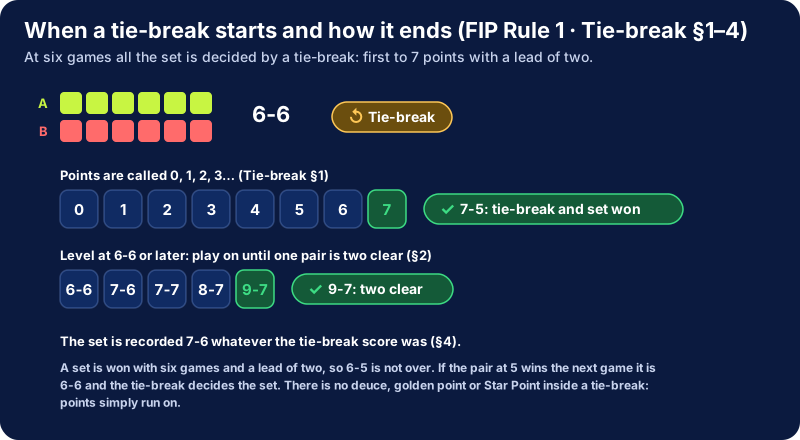
A set goes to the first pair with six games and a lead of two. At 5-5 you play on to 7-5; “if there is a tie at 6 games a ‘tie-break’ or sudden death will be applied” (Rule 1, Option 1 §2). The Spanish original heads the section Muerte súbita o “tie-break”, which is where the phrase sudden death comes from. The tie-break is the thirteenth game of the set and the last one.
Two exceptions exist in the rulebook, both of which have to be agreed before the match:
- A deciding set without a tie-break. At one set all, “and always previously established, the third set may be played without a ‘tie-break’”, so at 6-6 the set continues until one pair is two games clear (Option 1 §4). Clubs that play every set this way are following a local custom, not the FIP text, which allows it only for the third set.
- A mini-set to four games, with a tie-break at 4-4 instead of 6-6 (Alternative score methods §1a). Youth and consolation draws use it.
The tie-break rule is the same whichever deciding-point system the match uses. Advantage, Star Point and golden point only change how a game is finished from deuce; the tie-break section of Rule 1 is shared by all three. If you want the whole set and match structure first, start with how padel scoring works.
How the points are counted and when it ends
Inside a tie-break the 15-30-40 ladder disappears. “During tie-break, the points ‘zero’, ‘1’, ‘2’, ‘3’, etc., are called” (Tie-break §1). The tie-break “will be won by the first players to win 7 points, as long as it is with a 2 point advantage”, and with it they win “the ‘game’ and the ‘set’”; “if necessary tie-break continues until this margin is obtained” (§2).
So the answer to “to how many points” is 7, two clear:
| Score | Status |
|---|---|
| 7-5 | Tie-break over |
| 7-6 | Not over: one point lead only |
| 7-7, 8-8, 9-9 | Play on |
| 9-7, 10-8, 13-11 | Tie-break over: two clear |
There is no deuce, no advantage and no deciding point. A tie-break cannot be shortened by a golden point or a Star Point because those exist only at deuce in an ordinary game, at the first deuce for the golden point and the third for the Star Point; in a tie-break the points simply run on until the margin is there.
Whatever the final tie-break score, “a ‘tie-break’ set will be won by 7-6” (§4). A tie-break that finished 11-9 goes on the sheet as a 7-6 set, usually with the loser’s points in brackets: 7-6 (9).
Calling the score. The rulebook fixes only the words: zero, 1, 2, 3. The habit on professional courts, written into the FIP Tour’s umpiring instructions, is to say the points and then the name of the pair that leads, “4-2, López”, and “three equals” when level. In a friendly match the same habit avoids most arguments: say both numbers after every point, leader first.
Who serves in the tie-break: one point, then two and two
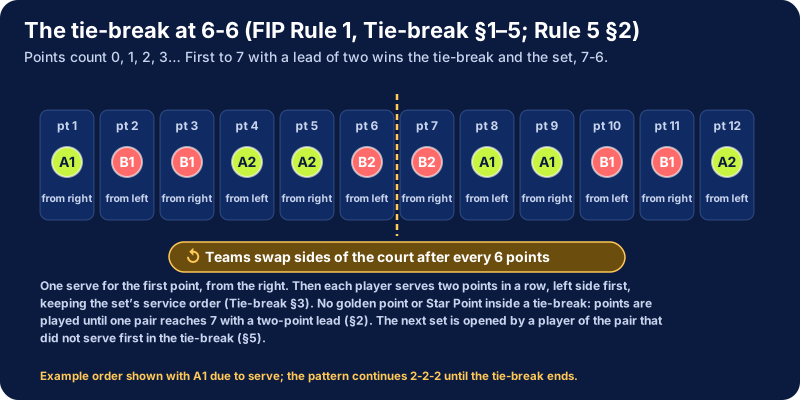
Tie-break §3 sets the whole sequence: “The ‘tie break’ will be started by the player whose turn it is to serve according to the order followed in the set. This player will only have one serve taken from the right side of court. The following two points will be served by the players of the opposite team respecting the previous order of service and serving from the left. After this the players will serve two consecutive points until the end of ‘the tiebreak’ always respecting the order of service.”
In practice:
- Point 1 is served by the player whose turn it is, from the right. Nobody chooses: the rotation of the set simply continues into the thirteenth game. If no one has served out of turn, that is the player who served the first game of the set, because the four-player rotation comes back to its start every four games (games 1, 5, 9 and 13).
- Points 2 and 3 are served by the next player in the order, from the other pair, starting on the left and then the right.
- From then on each player serves two points, left then right, in the same order as during the set. The receiving order is fixed too: “once the order has been decided it may not be altered during that set or tie-break” (Rule 8 §3).
A quick check if you lose track: the odd-numbered points of a tie-break (1, 3, 5, 7…) are always served from the right, the even ones from the left. And the player who served point 1 serves again at points 8 and 9, 16 and 17, and so on.
The mechanics of the normal rotation, who picks the first server of a set and what happens when someone serves out of turn, are in who serves in padel. The serve itself, feet, bounce and the diagonal box, is unchanged in a tie-break and is covered in the padel serve rules.
Swap sides every six points, no rest
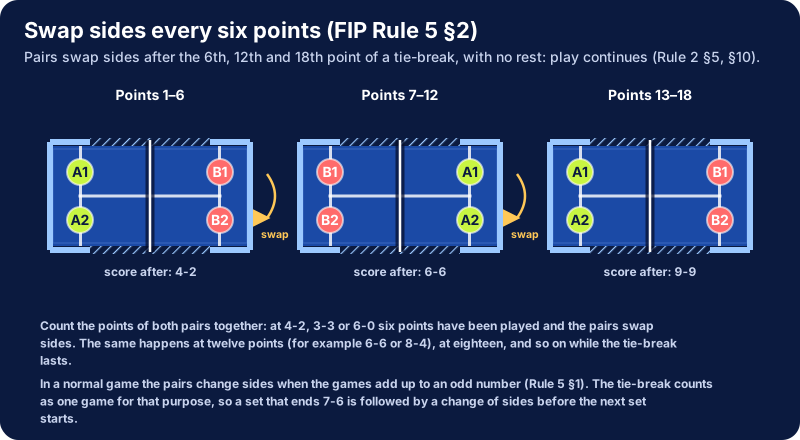
“In the ‘tie break’ the players will change ends (sides) after every 6 points” (Rule 5 §2). Count both pairs together: at 4-2, 3-3 or 6-0 six points have been played and you cross. The same at twelve (6-6, 8-4), eighteen (9-9) and so on for as long as the tie-break lasts. If a change is missed, “the correction should be made as soon as the mistake is discovered”; the points played on the wrong sides stand (Rule 5 §3).
On the rest, the rulebook says two things that read differently. Rule 2 §5: “after the first game of each set and during a tie-break, play will be continuous and the players will change ends without a rest period.” Rule 2 §10: “20 seconds will be granted for changes of side in a ‘tie break’.” Both sentences were already in the 2021 text, and the tennis rulebook has only the first of them. The consistent reading is that the 20 seconds of §10 are the same 20 seconds that §4 allows between any two points: you walk to the other end inside the normal time between points, without sitting down, drinking or towelling off at the bench. That is our reading; the text itself does not reconcile the two sentences. In a friendly match, cross quickly.
After the tie-break the pairs swap sides again before the next set starts. Under Rule 5 §1 the pairs change sides when the games played in the set add up to an odd number; a set that ends 7-6 has thirteen games.
Who serves the set after the tie-break
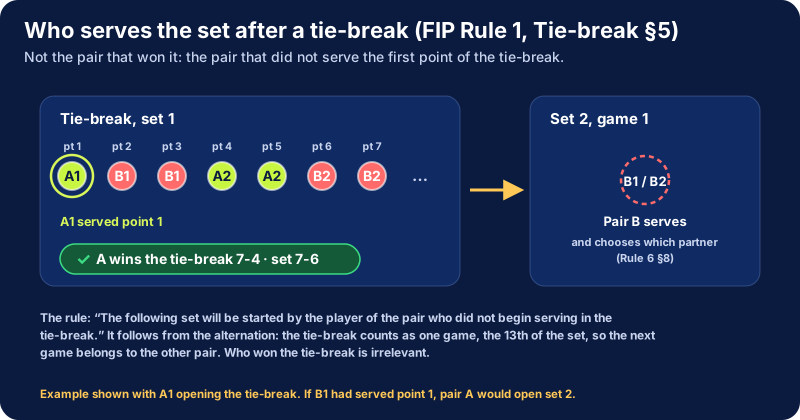
This is the detail that surprises most players. “The following set will be started by the player of the pair who did not begin serving in the ‘tie-break’” (Tie-break §5). Who won the tie-break has nothing to do with it; what matters is who served its first point.
The reason is arithmetic, not a special favour. The tie-break is one game, the thirteenth of the set. The pairs alternate service games, so the fourteenth game of the match, the first of the new set, belongs to the pair that did not serve the thirteenth. The tennis rules state the same outcome from the other side: the player who served first in the tie-break receives in the first game of the next set.
Which player of that pair serves is their choice. Rule 6 §8 lets each pair decide, before every set, which partner serves first, and the same goes for which partner receives first (Rule 8 §2). So pair B, opening set two after a tie-break that A1 started, can send B1 or B2 to the line, and the order between them for the new set follows from that choice.
If the tie-break decided the match, for example a super tie-break played instead of a third set, there is no next set and nothing to decide.
Super tie-break and match tie-break
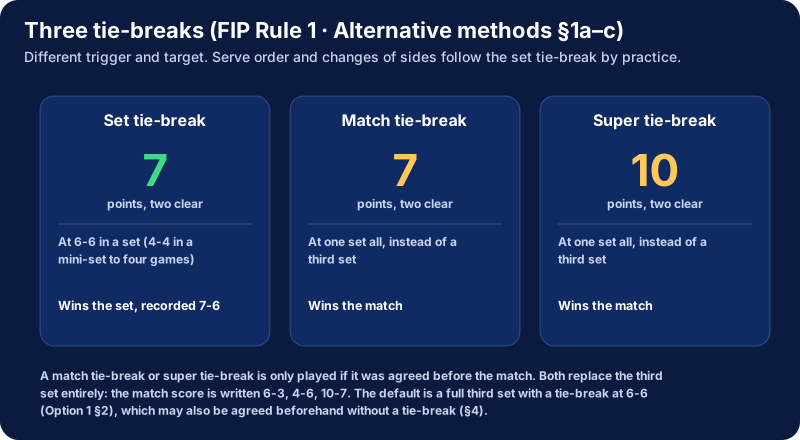
Besides the set tie-break, the rulebook lists two tie-breaks that replace the third set when the match stands at one set all. Both have to be agreed before the match:
- Match tie-break to 7 points. “When the score is one set all, a tie-break game will be played to decide the winner. This tie-break is final and replaces the last set”, won by the first pair to seven points with a two-point margin (Alternative score methods §1b).
- Super tie-break to 10 points. The same, but “the first pair to win ten points wins the super tie-break and the match, provided there is a minimum margin of 2 points” (§1c). This is the one clubs reach for when court time is short, and the one Spanish federation regulations prescribe for several of their categories: third-category national championships and the over-50 veterans’ circuit play two sets plus a super tie-break, while the over-35 to over-45 veterans and junior categories play best of three with a tie-break in every set.
The rulebook describes the match tie-break and the super tie-break only by their target. It does not repeat the serve sequence or the change of sides for them; the 2021 text had a note saying the original service order continues into a deciding tie-break and that each pair may reorder its server and receiver for it, and that note is no longer there. The usual practice, which the 2026 text does not spell out, is to play them exactly like a set tie-break: one serve, then two and two, a change of sides every six points, and the pair whose turn it is serves first. Agree that too before you start, and say out loud whether you are playing to 7 or to 10.
On the professional circuit the super tie-break is not used in 2026: the CUPRA FIP Tour rulebook says every match “will be played to the best of three sets, and all sets will be decided by a Tie-Break”, with the Star Point at deuce.
Mistakes we see on court
“We’ve won the tie-break, so we serve first.” No. The pair that did not serve the first point of the tie-break opens the next set (Tie-break §5), whoever won.
“The tie-break starts from the left, like every game’s second point.” No. The first point is served from the right (§3). Odd points right, even points left.
“Each pair serves two points from the start.” Only the first server serves a single point. The two-and-two pattern begins with the second server (§3).
“We swap sides at 3-3 and 6-6 only.” The pairs swap sides after every six points played, whatever the split: 4-2, 5-1 and 6-0 all count (Rule 5 §2). And again at twelve, eighteen and so on.
“It’s 6-6 in the tie-break, so it’s a golden point.” There is no golden point or Star Point inside a tie-break. Play on until one pair leads by two (§2).
“We’re sitting down at the change, it’s a changeover.” Not in a tie-break: play is continuous and the change of sides is made within the normal time between points (Rule 2 §5 and §10).
“The set was 7-6 (11-9), so we write 11-9.” The set is recorded 7-6 (§4); the tie-break score goes in brackets if you want to keep it.
Sources
All rule statements on this page were checked against the official texts below on 9 October 2026.
- FIP, Rules of Padel, revision applying from 01.01.2026: Rule 1 “Score in a game”, Option 1 §2 to §4, “Tie-break” §1 to §5 and “Alternative score methods” §1a to §1c; Rule 2 “Times” §4, §5 and §10; Rule 5 “Changes of sides” §1 to §3; Rule 6 “The serve” §8; Rule 8 “Return of serve” §2 and §3 (English): padelfip.com/…/FIP_Rules-of-Padel.pdf. Spanish original, Reglas del Pádel, Regla 1 (Puntuación, Muerte súbita o “tie-break”, Métodos de puntuación alternativos), Regla 2 §4, §5 y §10, Regla 5, Regla 6 §8, Regla 8 §2 y §3: padelfip.com/…/FIP_Reglas-del-Padel.pdf. If the FIP link moves, we keep a reduced-size copy of the Spanish text as downloaded on 7 October 2026; the FIP site is the authoritative version.
- FIP, Reglamento de Juego del Pádel, revision applying from 28.05.2021, “Muerte súbita o tie-break” §1 to §5, Regla 2 §5 and §10, and “Métodos de puntuación alternativos” Nota 1 and Nota 2, used to confirm that the tie-break text is unchanged in 2026 and that the notes on the deciding tie-break were dropped. Federation mirror: fmpadel.com/docs/FIP-Reglamento-Juego.pdf.
- FIP, CUPRA FIP Tour Official Rulebook, version 2026, section 11.1.9 “Scoring system” (best of three sets, tie-break in every set, Star Point) and the chair umpire’s announcements during a tie-break: padelfip.com/…/Cupra-FIP-Tour-Rulebook_EN-1-1-1.pdf.
- Federación Española de Pádel, Reglamento Técnico General 2026 (amendments approved on 13 March 2026), articles 3.5.4.35, 3.8.4 and 3.10.17.1 (formats with a super tie-break or a tie-break in every set): padelfederacion.es/…/RTG CD 13-3-26.pdf. The FEP publishes the FIP 2026 rules as its rules of play: padelfederacion.es/…/FIP_Reglas-del-Padel-1.pdf.
- ITF, Rules of Tennis (2022 edition), rule 5 “Score in a set” (tie-break game) and rule 29 “Continuous play”, used only for the comparison with tennis: itftennis.com.
- The diagrams on this page are our own drawings. They illustrate the rule text; where a drawing and the text could be read differently, the text applies.
Frequently asked questions
How many points is a padel tie-break?
Seven, with a lead of two. Points are counted 0, 1, 2, 3 and so on, and the first pair to reach 7 points two clear wins the tie-break, the game and the set (FIP Rule 1, Tie-break §1 and §2). At 6-6 or 7-7 inside the tie-break you keep playing until one pair leads by two. A super tie-break, which some formats play instead of a third set, goes to 10 points, also two clear.
Who serves first in a padel tie-break?
The player whose turn it is to serve in the set’s rotation, and that player serves only one point, from the right-hand side. The other pair then serves two points, starting from the left, and from there every player serves two points in a row in the set’s order (Tie-break §3). If nobody has served out of turn, the first server of the tie-break is the player who served the first game of the set.
How often do you swap sides in a tie-break?
Every six points: after the 6th, 12th and 18th point and so on (FIP Rule 5 §2). Add both pairs’ points together: 4-2, 3-3 and 6-0 are all six points. The next change of sides comes with the next set, because the tie-break counts as a game and a set that ends 7-6 has an odd number of games.
Is there a rest when you swap sides in a tie-break?
No sitting down. Rule 2 §5 says that during a tie-break play is continuous and the pairs swap sides without a rest, while Rule 2 §10 allows 20 seconds for a tie-break change of sides, the same 20 seconds that Rule 2 §4 allows between any two points. Read together: cross to the other end within the usual time between points and play on.
How is the set recorded after a tie-break?
As 7-6 to the pair that won the tie-break, whatever the tie-break score was (Tie-break §4). A tie-break won 12-10 is still a 7-6 set. The tie-break score is often written after it in brackets, 7-6 (10).
Who serves after a tie-break in padel?
A player of the pair that did not serve the first point of the tie-break (Tie-break §5). It does not matter who won it. That pair chooses which of its two players serves, as every pair does at the start of a set (Rule 6 §8). If a super tie-break was the deciding set, the match is over and the question does not arise.
Keep the real score, live.
Pair your remote and let PadelRef call the score for you.