Padel serve rules 2026: what counts and what is a fault
Rules version: this article follows the FIP Rules of Padel, revision applying from 1 January 2026 (approved in Acapulco on 28 November 2025), which the Spanish federation (FEP) also publishes as its own rules of play. Published 7 October 2026 · last checked 7 October 2026. We re-read the FIP and FEP texts whenever they change and update this page; the sources are listed at the end.
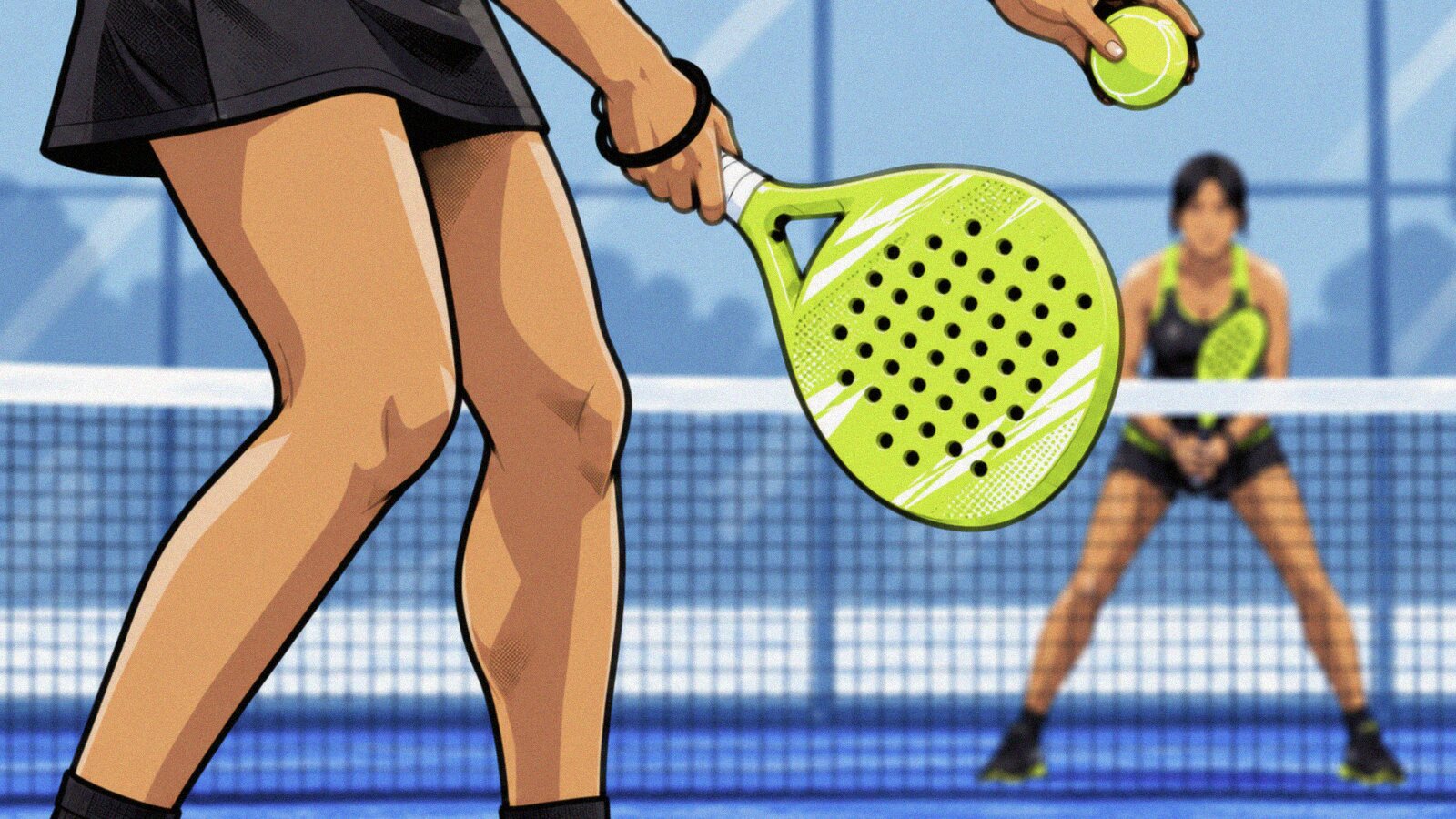
The padel serve is underarm, bounced and diagonal, and it is the shot beginners get called for most often. The 2026 revision of the FIP rulebook changed the one part of it people argue about on every court: where your feet have to be. This page goes through the serve rule by rule, with a diagram for each case, and ends with the faults that still start arguments.
A valid serve in five points
- Stand behind the service line with at least one foot, inside your own service zone: between the imaginary extension of the centre line and the side wall. No foot may touch the service line or that imaginary line, and you stay there until you have hit the ball.
- Bounce the ball on the ground inside your own zone, behind the line. It may not cross the service line or the imaginary centre line before you hit it.
- Hit it at waist height or below, with at least one foot on the ground.
- Send it diagonally into the receiving box across the net. The first point of each game is served from the right-hand side, the next from the left, and so on. The lines belong to the box.
- You get two attempts. A fault on the first serve gives you a second; a second fault loses the point.
Everything else on this page is detail on one of those five points. The rule references are to the FIP Rules of Padel 2026: the serve is Rule 6, service faults are Rule 7, the return is Rule 8 and the replayed serve is Rule 9.
Where to stand: one foot behind the line (new in 2026)
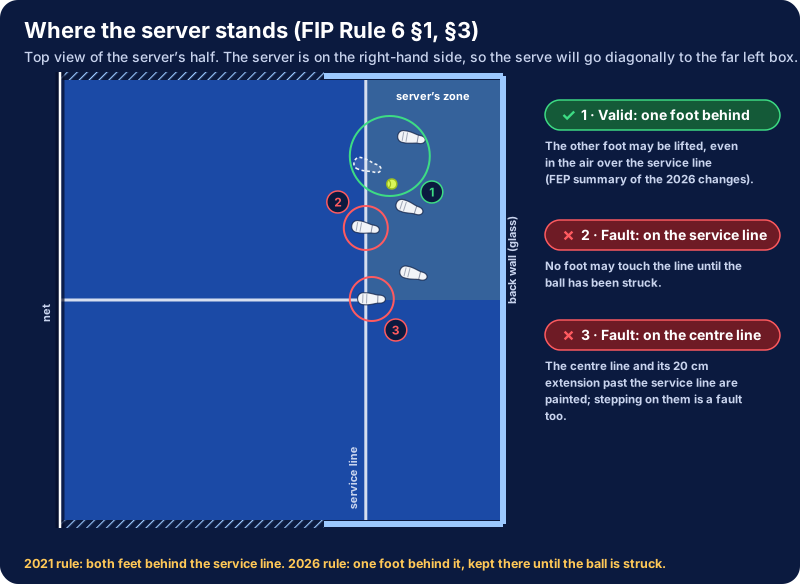
Rule 6 §1 says the server must stand “with one foot behind the service line, between the imaginary prolongation of the central line of serve and the sidewall (service box) and must remain there until the ball has been served”. Rule 6 §3 adds that the server may not touch the service line or the imaginary centre line with the feet. Doing either is a service fault (Rule 7 §1a).
Three things follow from that wording:
- One planted foot is enough. The other foot may be lifted, and it may even be in the air over the line. The Spanish federation’s own summary of the 2026 changes puts it bluntly: one foot in the service zone, the other may invade in the air.
- The centre line counts as a line. The painted centre line runs from the net to the service line and at least 20 cm past it, and that painted stub is what marks where your zone ends; the rule also treats its continuation towards the back wall as a line. Stepping on either is a fault.
- “Until the ball has been served” means until you hit it. After contact, you can run forward, step on the line or cross it. Before contact, you cannot.
What changed. The 2021 rulebook required the server to have both feet behind the service line and to keep them there until the ball was struck. The 2026 text reduces that to one foot. If you learned the serve before 2026 and someone tells you a lifted back foot over the line is a fault, they are quoting the old text.
The bounce and the height: at or below the waist
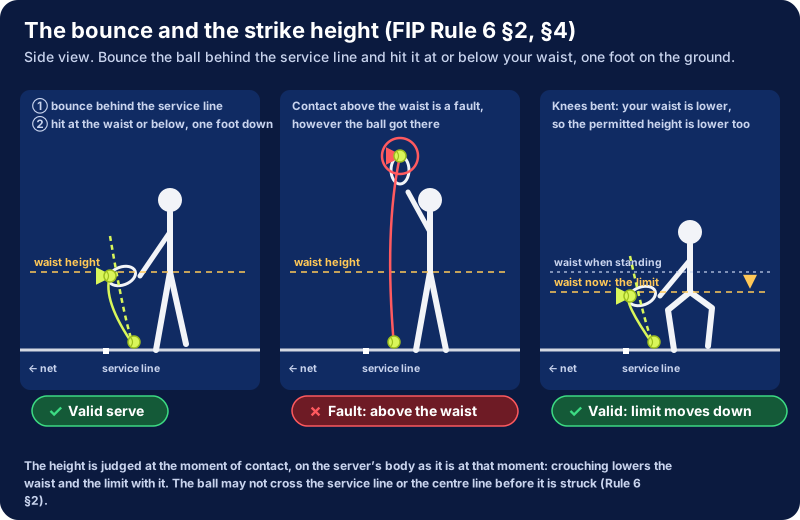
The server “must bounce the ball on the ground to serve, within the corresponding box in which they are to serve” (Rule 6 §2). The bounce therefore happens behind the service line, in your own zone, not in front of it. The 2026 text adds a sentence that was not in the 2021 rules: the ball may not cross the service line or the imaginary centre line before it is struck. A bounce that drifts over the line before you hit it is a fault.
At the moment of contact “the height of the ball being served must be at or below the waist level”, and “the player must have at least one foot in contact with the ground” (Rule 6 §4). This is the rule that makes the padel serve different from tennis: there is no overhead serve, because the contact point would be above the waist. It is also the rule that rules out a jump serve, since both feet would be off the ground.
Waist height is measured on you, as you are at the moment of contact. Bending your knees or crouching does not buy you a higher contact point: your waist moves down with you, and so does the limit. The 2021 edition of the rules spelled this out in a case ruling (“at what maximum height may a player who flexes the legs strike the ball? At the height of the waist at that moment, or below”); the 2026 text dropped the case rulings but kept the wording “at the moment of hitting it”, so the reading is unchanged. In practice a low, crouched contact is perfectly legal, it is just lower.
The 2021 text had a separate sentence forbidding the server to walk, run or jump during the serve. That sentence is gone from the 2026 text. In practice nothing changes for a jump, because of the one-foot-on-the-ground requirement; what the deletion removes is the argument about small steps and shuffles before contact.
A swing that misses the ball still counts as a serve: “at the moment contact is made with the ball, or in an intentional attempt to hit it, it will be considered a serve” (Rule 6 §6), and missing the ball when trying to hit it is a fault (Rule 7 §1b).
Which box to serve into, and in what order
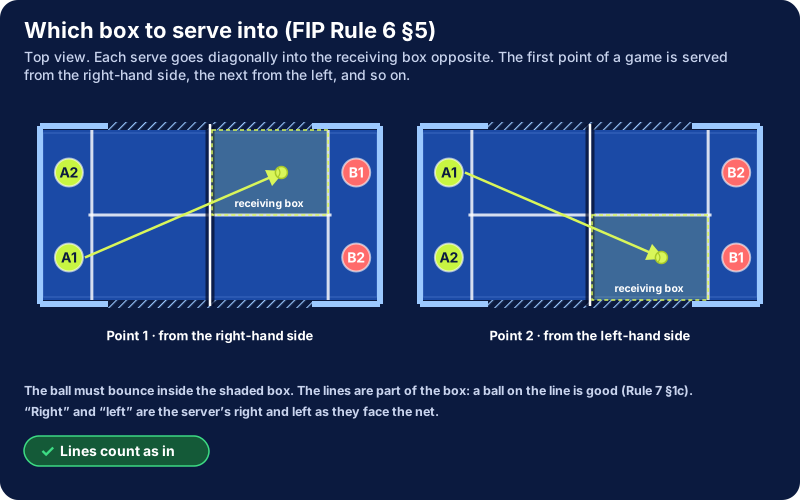
Rule 6 §5: the ball “should pass diagonally over the net towards the receiving box” and “must bounce within the lines that limit this box”. The first serve of a game goes to the box on the server’s left as they face the net, which means the server stands on the right-hand side of their own court. When the point is over, the next serve is from the left-hand side into the other box, and so on alternately until the game ends. A ball that lands on a line of the receiving box is good (Rule 7 §1c).
The receiver stands diagonally opposite the server (Rule 3 §1). The receiver may stand anywhere on their side of the court to wait for the serve, and so may the receiver’s partner and the server’s partner (Rule 3 §2); there is no rule about where the non-receiving players stand.
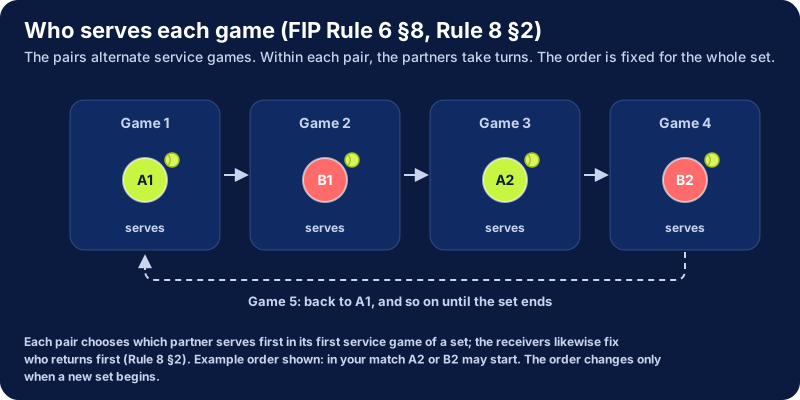
The pairs alternate service games. Before each set, each pair decides which partner will serve first in that pair’s service games, and “once the order has been established it may not be changed until the beginning of the following set” (Rule 6 §8). The receiving pair likewise decides in the first game of the set who receives first, and that player keeps receiving the first serve of every game until the set ends (Rule 8 §2), with the partners alternating within the game (Rule 8 §3).
Service faults: the official list
Rule 7 §1 lists exactly six ways a serve is a fault:
| The serve is a fault if… | Rule | |
|---|---|---|
| a | the server breaks any of Rule 6 points 1 to 6: foot position, bounce, touching a line, strike height, foot off the ground, wrong box | 7 §1a |
| b | the server swings at the ball and misses | 7 §1b |
| c | the ball bounces outside the receiver’s service box (the lines count as in) | 7 §1c |
| d | the ball hits the server, the server’s partner, or anything either of them wears or carries | 7 §1d |
| e | the ball bounces in the receiver’s box and then touches the metal fence before the second bounce | 7 §1e |
| f | the ball bounces in the receiver’s box and then goes straight out through the gate of a court that has no safety zone, where out-of-court play is not allowed | 7 §1f |
Two consecutive faults lose the point (Rule 13 §1q). A “net” (next section) is not a fault and does not use up a serve.
Net serve and let: when the serve is replayed
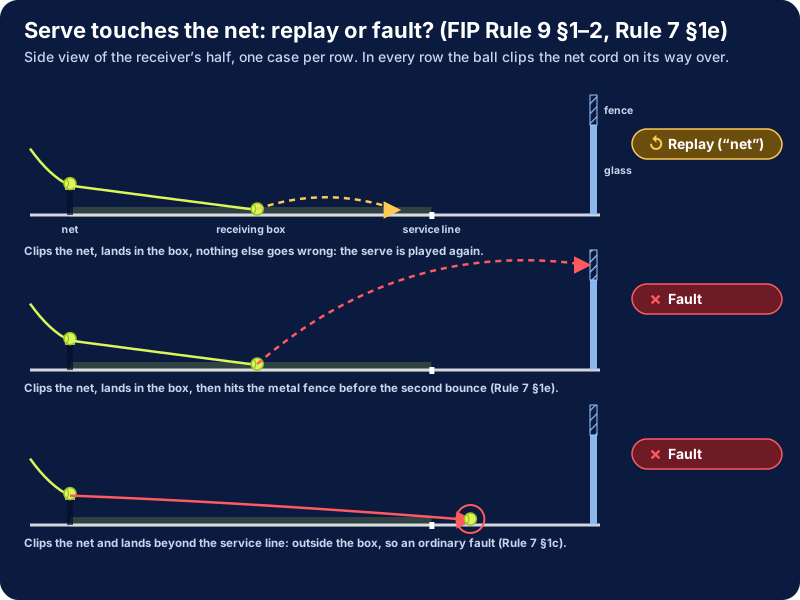
The rulebook uses two words here, and it is worth knowing both because club Spanish uses “let” for everything:
- A serve is a “net” when the ball “touches the net or the supporting posts and then lands in the receiver’s service box, as long as it does not touch the metallic fence before the second bounce” (Rule 9 §1a). It is also a “net” if the ball, after touching the net or posts, hits a player or anything they wear (Rule 9 §1b).
- The serve is repeated (“let”) when it is made while the receiver is not ready (Rule 9 §2a, Rule 6 §10).
Either way the serve is played again, and there is no limit on how many times. The only question is how much is replayed: a let on the first serve means “the complete point repeated”, so the server gets two serves again; a net or let on the second serve gives the server “only the right to repeat the second serve” (Rule 9 §2b–c).
Two consequences that get missed:
- A serve that clips the net and lands outside the box is simply a fault. The net touch does not save it.
- A serve that clips the net, lands in the box and then hits the fence before the second bounce is a fault, not a net (Rule 9 §1a read with Rule 7 §1e).
On the “not ready” let: the server “will not serve until the player receiving is ready”, but the receiver “will adapt within reasonable to the rhythm of the server” (Rule 6 §10). A receiver who has tried to return the serve cannot then claim they were not ready, and if the receiver really was not ready, a fault cannot be called against the server either (Rule 6 §11).
Glass or fence after the bounce
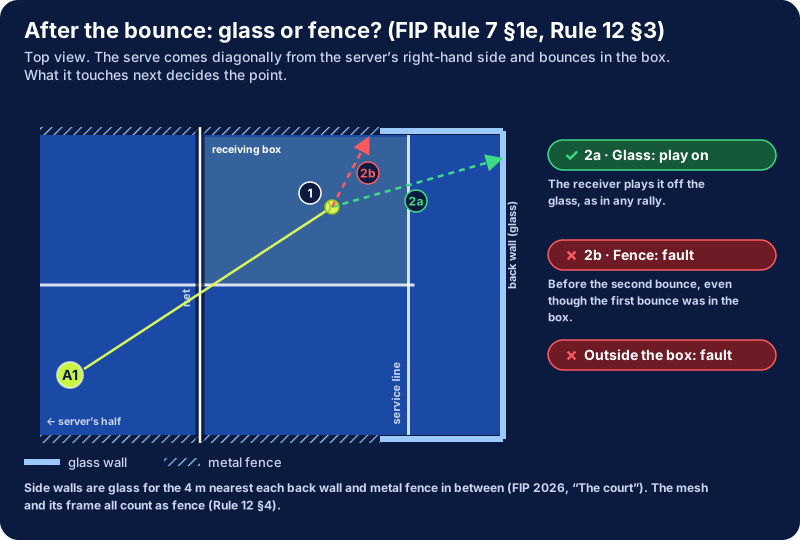
Once the serve has bounced inside the box, what it touches next decides whether it is still a serve in play:
- Glass: play continues. A ball that “hits any part of the court after having bounced in the opponent’s ground” stays in play and must be returned before the second bounce (Rule 12 §3). The receiver plays it off the back glass like any other ball.
- Metal fence: fault, if it happens before the second bounce (Rule 7 §1e). “The mesh and frame in its entirety will be considered as part of the fence” (Rule 12 §4), so hitting the frame counts too.
- Out through the door: fault, on a court with no safety zone and no out-of-court play (Rule 7 §1f).
This is why the side of the receiving box matters. On a standard court the side walls are glass for the 4 m nearest each back wall and metal fence for the 12 m in between. A hard, wide serve that bounces in the box and kicks sideways is therefore heading for fence, not glass.
The return: why you cannot volley the serve
The receiver “will have to wait for the ball to bounce within their receiving box of service and hit it before it bounces on the ground for the second time” (Rule 8 §1). Volleying the serve is not an option in padel, however tempting a soft second serve looks.
If the serve hits the receiver or the receiver’s partner, or either of their rackets, before it has bounced, the point goes to the server (Rule 8 §5). The receivers cannot claim the ball was going out; it had not bounced, so nobody knows.
The receiving order is fixed for the set in the same way as the serving order (Rule 8 §2–3). If the receivers swap by mistake, they finish that game or tie-break as they are and go back to the original order from the next game (Rule 8 §4).
Valid, fault or replay: the summary table
| Situation | Outcome | Rule |
|---|---|---|
| One foot behind the service line at contact, the other in the air | Valid | 6 §1 |
| A foot touches the service line or the imaginary centre line before contact | Fault | 6 §3, 7 §1a |
| Ball bounced in your own zone, behind the line | Valid | 6 §2 |
| Ball crosses the service line or imaginary centre line before you hit it | Fault | 6 §2, 7 §1a |
| Contact at or below the waist, one foot on the ground | Valid | 6 §4 |
| Contact above the waist, or both feet off the ground | Fault | 6 §4, 7 §1a |
| Knees bent, contact at the (lowered) waist | Valid | 6 §4 |
| Ball lands on a line of the receiving box | Valid | 7 §1c |
| Ball lands outside the receiving box | Fault | 7 §1c |
| Swing and miss | Fault | 7 §1b |
| Serve hits the server or the server’s partner | Fault | 7 §1d |
| Bounces in the box, then hits the glass | Valid, play on | 12 §3 |
| Bounces in the box, then hits the fence before the second bounce | Fault | 7 §1e |
| Bounces in the box, then straight out through the gate (no safety zone) | Fault | 7 §1f |
| Bounces in the box, then goes out over the fence or wall without touching it | Valid: server’s point (no out-of-court play) | 13 §1d, 14 §1d |
| Touches the net or posts, lands in the box, no fence before the second bounce | Net: replay | 9 §1a |
| Touches the net, lands in the box, then hits the fence | Fault | 9 §1a, 7 §1e |
| Touches the net, lands outside the box | Fault | 7 §1c |
| Served while the receiver is not ready | Let: replay | 9 §2a |
| Receiver hits or is hit by the serve before it bounces | Server’s point | 8 §5 |
| Second consecutive fault | Point lost | 13 §1q |
Cases that get argued about
Serving from the wrong side. If a serve is “inadvertently made from the wrong side”, the error is corrected as soon as it is noticed. The points already played stand, and a fault on the first serve is carried over (Rule 6 §7).
Serving out of turn. The player who should have served takes over as soon as the mistake is discovered; points already won are valid. A single service fault before the error is discovered is ignored. If the whole game was played by the wrong server before anyone noticed, the altered order stays until the end of the set (Rule 6 §9).
“Can I serve overhead?” Only if your contact point is at or below your waist, which an overhead swing cannot manage. The rule does not ban the swing; it bans the height (Rule 6 §4).
“If I bend my knees, can I hit it higher?” No. The waist is wherever your waist is at the moment of contact, so crouching lowers the limit rather than raising it (Rule 6 §4; the 2021 edition’s case ruling said the same in so many words).
“Can I jump?” Not at the moment of contact: at least one foot must be on the ground (Rule 6 §4). The 2021 sentence that banned jumping outright is no longer in the text, so a hop before the bounce is not, by itself, a fault.
“Can I bounce the ball twice before I hit it?” The rulebook says the server “must bounce the ball on the ground” inside their zone; it does not count the bounces. What matters is that the bounce you hit from is in your zone, behind the line, and that the ball does not cross the line before you strike it (Rule 6 §2). The serve is considered made when you hit the ball or intentionally try to (Rule 6 §6), not when you first bounce it.
“My foot landed on the line after I hit it.” Legal. The feet must stay in the zone “until the ball has been served” (Rule 6 §1); what happens after contact is not a fault.
“The serve hit my partner.” Fault (Rule 7 §1d). It does not matter whether your partner was standing at the net or at the back.
“The receiver’s partner was standing in the receiving box.” Allowed. The receiver’s partner and the server’s partner “can be in any part of their side of the court” (Rule 3 §2). If the serve hits the receiver’s partner before it bounces, the server wins the point (Rule 8 §5).
“Where does the receiver have to stand?” Nowhere in particular. The receiver may stand anywhere on their side (Rule 3 §2), but must let the ball bounce in the box before hitting it (Rule 8 §1).
If you are learning the serve, you will also want to know how padel scoring works, including what happens at 40-40 under the three deciding-point methods, and the Star Point, the 2026 scoring rule.
The lob serve: legal, rare and easy to punish
Nothing in Rule 6 says how hard or how high you have to serve. That leaves room for a serve you will rarely see outside advanced games: a very high, slow lob, struck at waist height, that drops almost vertically into the receiving box and, after a single bounce, climbs over the side fence and leaves the court without touching it.
By the letter of the rules it is a valid serve and, on most courts, a won point:
- The serve itself has to meet the usual five points: bounce behind the line, contact at or below the waist, diagonal into the box. The height and speed of the ball are not regulated (Rule 6).
- A ball that bounces in the box and then touches the fence is a fault (Rule 7 §1e). A ball that clears the fence without touching anything commits no service fault: the six faults in Rule 7 §1 do not include it.
- On a court without out-of-court play, the receiving pair loses the point when the ball, after bouncing in their court, “goes over the marked limit (outer perimeter) of the court (lateral or end) or through the gate” (Rule 13 §1d). Rule 14 §1d says the same from the hitter’s side: a ball that bounces in the opponents’ court and then goes out of court, or hits the ceiling or the lights, is a correct return.
- On a court with out-of-court play authorised (Rule 16), a ball that goes out over the side wall or through the door is still live: the point is lost only when it bounces a second time or touches something outside the court (Rule 13 §1e). The receiver can run out and play it. Over the back wall, the point is lost straight away.
- One exception to remember: a serve that bounces in the box and goes straight out through the gate on a court with no safety zone is a fault, not a point (Rule 7 §1f). The fence, not the door.
Why you do not see it often:
- It is hard to hit. The side enclosure is 3 m high along most of the court and 4 m at the ends (FIP, “The court”). To clear it after one bounce, the ball has to come down almost vertically from well above the fence, land in the box and still have enough bounce left. From a waist-high contact that is a demanding shot, and a slightly short or flat version is a soft serve that sits up for the receiver.
- The receiver has a simple answer. The receiver may stand anywhere on their side (Rule 3 §2), so a receiver who sees the lob coming steps in and takes the ball right after the bounce, before it climbs (Rule 8 §1 only requires that it bounce first). A high, slow serve is also the easiest serve to attack.
- Etiquette. In club padel the lob serve is widely regarded as a trick serve, and some players consider it poor form. It is legal; whether it is welcome is a question for the people you play with.
A note for indoor courts: under Rule 14 §1d a ball that bounces in the opponents’ court and then hits the ceiling or the lights is a correct return, but many indoor clubs run a local rule that treats the roof as out. Ask before you rely on it.
Sources
All rule statements on this page were checked against the official texts below on 7 October 2026.
- FIP, Rules of Padel, revision applying from 01.01.2026: “The court”, Rule 3 “Position of the players”, Rule 6 “The serve”, Rule 7 “Serve fault”, Rule 8 “Return of serve”, Rule 9 “Repeat or ‘let’ and ‘net’ serve”, Rule 12 “Ball in play”, Rule 13 “Point lost”, Rule 14 “Correct return”, Rule 16 “Authorized out-of-court play” (English): padelfip.com/…/FIP_Rules-of-Padel.pdf. Spanish original, Reglas del Pádel, Reglas 3, 6, 7, 8, 9, 12, 13, 14 and 16: padelfip.com/…/FIP_Reglas-del-Padel.pdf. If the FIP link moves, we keep a reduced-size copy of the Spanish text as downloaded on 7 October 2026; the FIP site is the authoritative version.
- FIP, Reglamento de Juego del Pádel, revision applying from 28.05.2021, Regla 6 §2 (both feet behind the service line) and §7 (no walking, running or jumping), used only to document what changed in 2026. Federation mirror: fmpadel.com/docs/FIP-Reglamento-Juego.pdf.
- Federación Española de Pádel, 2026 – Reglamento de juego, summary of the FIP changes (foot fault: one foot in the service zone, the other may be in the air; the ball may not cross the service line before it is struck): padelfederacion.es/…/Resumen-cambios-reglamento-FIP.pdf. The FEP publishes the FIP 2026 rules as its rules of play: padelfederacion.es/…/FIP_Reglas-del-Padel-1.pdf.
- The diagrams on this page are our own drawings, made to the court measurements in the FIP rules (“The court”: 10 × 20 m, service lines 6.95 m from the net, centre line extended at least 20 cm past the service line, glass back walls, side walls glass for 4 m from each back corner and metal fence in between). They illustrate the rule text; where a drawing and the text could be read differently, the text applies.
Frequently asked questions
Can you serve above the waist in padel?
No. At the moment you hit it, the ball must be at or below your waist (FIP Rule 6 §4). That is why an overhead, tennis-style serve is a fault: the contact point is above the waist. The waist is measured as you are at that moment, so bending your knees lowers the limit rather than raising it.
What happens if the serve touches the net?
If it touches the net or the posts and then lands in the correct receiving box without hitting the metal fence before its second bounce, it is a “net” and the serve is replayed, with no limit on repeats. If it lands outside the box, or lands in the box and then hits the fence, it is a fault (Rule 9 §1, Rule 7 §1e).
Is it a fault if the serve bounces in the box and then hits the fence?
Yes. A serve that bounces inside the receiving box and touches the metal fence before the second bounce is a fault (Rule 7 §1e). If it hits the glass instead, play continues and the receiver returns it off the wall.
Can you step on the line when serving?
Not before you hit the ball. The server may not touch the service line or the imaginary extension of the centre line with either foot, and must stay behind the line until the ball has been struck (Rule 6 §1, §3). Once the ball is on its way you can move freely.
How many serves do you get in padel?
Two. If the first serve is a fault you get a second one; a second consecutive fault loses the point (Rule 6, opening paragraph, and Rule 13 §1q). A “net” is not a fault: it is replayed.
Can you volley the return of serve?
No. The receiver must let the serve bounce inside the receiving box and hit it before the second bounce (Rule 8 §1). If the serve hits the receiver or their partner, or their racket, before it bounces, the point goes to the server (Rule 8 §5).
What changed in the padel serve rules in 2026?
Two things. The server now needs only one foot behind the service line at the moment of striking the ball, where the 2021 text required both feet; and the rule now says explicitly that the ball may not cross the service line or the imaginary centre line before it is struck. The 2021 sentence forbidding walking, running or jumping while serving was dropped; at least one foot must still be on the ground at contact.
Is a lob serve legal in padel?
Yes. The rules fix where you stand, where the ball bounces and the height of contact, not how high or how slowly you hit it. A high lob that lands in the receiving box and then goes out over the fence without touching it is a valid serve, and on a court without out-of-court play the receivers lose the point (Rule 13 §1d). If it touches the fence before the second bounce, it is a fault (Rule 7 §1e). Most players avoid it: it is hard to hit, easy to attack if it falls short, and treated as poor form at club level.
Keep the real score, live.
Pair your remote and let PadelRef call the score for you.