Padel rules 2026: every FIP rule change, explained
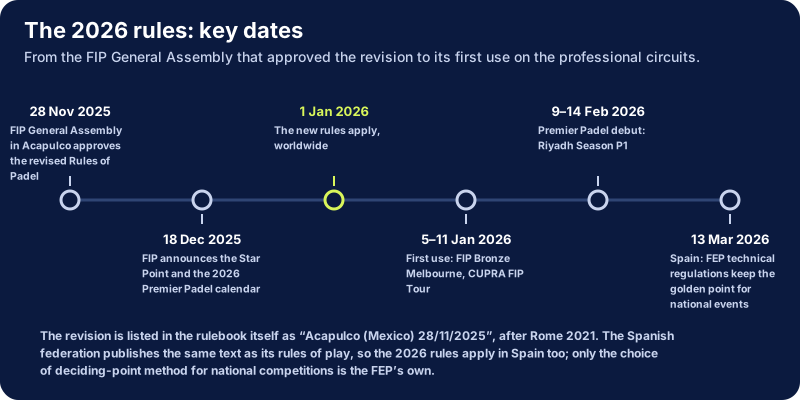
Rules version: this article follows the FIP Rules of Padel, revision applying from 1 January 2026 (approved in Acapulco on 28 November 2025), compared line by line with the previous revision of 28 May 2021. The Spanish federation (FEP) publishes the 2026 text as its own rules of play. Published 9 October 2026 · last checked 9 October 2026. We re-read the FIP and FEP texts whenever they change and update this page; the sources are listed at the end.
The 2026 revision of the FIP Rules of Padel is the first rewrite of the game’s rules since 2021. It adds a third way to finish a game, rewrites the serve’s foot rule, shortens the warm-up, tells players when they may drink, and adds a penalty ladder for slow play. It also quietly removes every “case and decision” that used to explain the rules, drops the ban on sleeveless shirts and changes a dozen measurements of the court, the ball and the racket.
This page lists every difference we found by comparing the two texts, with the rule number for each one, and separates the changes that affect how you play from the ones you will never notice. If you only want the headline, it is this: Star Point, one foot, three minutes, no drinking between points.
The 2026 changes in one table
| What | Until 2025 | From 2026 | Rule |
|---|---|---|---|
| Finishing a game at 40-40 | Advantage (Method 1) or golden point (Method 2) | Star Point added as Option 2: two advantages, then one deciding point. Golden point becomes Option 3 | Rule 1 |
| Server’s feet | Both feet behind the service line until the ball is struck; no walking, running or jumping | One foot behind the line, kept there until the ball is hit. The walking and jumping clause is gone | Rule 6 §1 |
| The bounce before the serve | Bounce the ball inside your service box | New sentence: the ball may not cross the service line or the imaginary centre line before it is struck | Rule 6 §2 |
| Warm-up | 5 minutes, compulsory | 3 minutes, compulsory | Rule 2 §2 |
| Warm-up after an interruption | 5 to 20 minutes stopped: 3 minutes; over 20: 5 minutes | 1 minute and 3 minutes | Rule 2 §11 |
| Eating and drinking | Not mentioned | No liquids or food between points | Rule 2 §5 |
| Slow play | Generic conduct penalties | New ladder: warning, then loss of the first serve (or of a point when not serving), then a point for each further delay | Continuous play and/or delay of game |
| Let for an object on the floor | Not a let | New let when the ball hits an object on the opponents’ floor and the object moves so that it could interfere or be dangerous | Rule 10 §1d |
| Strap breaks or the racket slips | Not stated | The pair loses the point immediately | Rule 13 §1r |
| Involuntary interference | Point replayed | Replayed the first time; a second involuntary interference by the same pair loses the point | Rule 11 |
| Medical time | 3 minutes per injury, once per player; 15 minutes for accidents outside play | Same, plus: the 3 minutes are per treatable condition; the 15-minute accident clause lists fainting, allergic reactions, dizziness and breathing crises; a new 5-minute recovery for unusual incidents such as a fall or a ball hitting a player | Rule 2 §14 to §17 |
| Coaches | One penalty table for players and coaches | Separate coach table: warning, then expulsion from the match. Coaching during medical, toilet or weather stoppages is at the umpire’s discretion | Penalties table; “Advice and instructions” |
| Lost or damaged ball | Replace with a ball in the same condition, or the whole set | New ball if lost in the first two games after a ball change, otherwise a used ball of similar wear; never play with only one ball | Rule 17 §e |
| Clothing | Sports clothing; no sleeveless shirts, no swimwear | Sports clothing; no swimwear. The sleeveless-shirt ban is dropped | Attire |
| Deciding tie-break notes | Service order continues into a match tie-break; no ball change at its start | Both notes removed | Alternative score methods |
| Cases and decisions | Worked examples after many rules | All removed | Throughout |
| Court | Centre line extends 20 cm past the service line; advertising strip on the net band up to 9 cm; four side-wall variants; wall colours preferred; safety area 2 m wide; access gaps 2.00 and 1.00 m; lighting tables | Centre line extends at least 20 cm; net band, strip included, up to 11 cm in total; two side-wall variants; walls any single colour that does not hinder play; floor one colour; safety area 3 m wide (4 recommended); gaps 2.20 and 1.10 m; lighting tables dropped | The court |
| Ball | White or yellow; altitude balls above 500 m | White, yellow or any colour that contrasts with the floor; altitude balls above 1000 m | The ball |
| Racket | Peripheral holes may have another shape or size | Peripheral holes may differ but no larger than 20 mm | The racket §6 |
Everything else, from the 20 seconds between points to the 7-point tie-break, reads as it did in 2021. The “what did not change” list is further down.
Star Point: the new scoring option
Rule 1 used to offer two ways to finish a game from 40-40: the classic advantage and the golden point. The 2026 text inserts a third one between them, the Star Point, as Option 2, and renumbers the golden point as Option 3. At 40-40 the umpire calls “deuce 1”; the pair that wins the next point has “advantage 1” and wins the game with the point after. If it loses, the score is “deuce 2”, then “advantage 2”, and if that is lost as well, “deuce 3” and a single deciding point, the Star Point. On that point “the receiving pair will choose whether to receive the service on the right or the left side of the court” and “cannot change positions”; in mixed doubles the player of the same sex as the server receives (Rule 1, Option 2 §1 and §2).
Three things about it are misreported more than any other 2026 change:
- It is not a golden point. Several guides say the game “ends with a golden point after two advantages”. The deciding point works the same way, but the rulebook calls it the Star Point and keeps the golden point as a separate option played at the first deuce, not the third.
- It replaces nothing. Advantage and golden point are still in the text. Each competition chooses, and in 2026 the Star Point is the choice of Premier Padel, the CUPRA FIP Tour, FIP Promises and FIP Beyond.
- The deciding point has no fixed side. The receivers pick it, exactly as on a golden point.
The full mechanics, the calls, the history and where it is played are in our guide to the Star Point; the three options side by side, and how they fit into games, sets and the tie-break, are in how padel scoring works.
The serve: one foot behind the line, and the ball stays behind it too
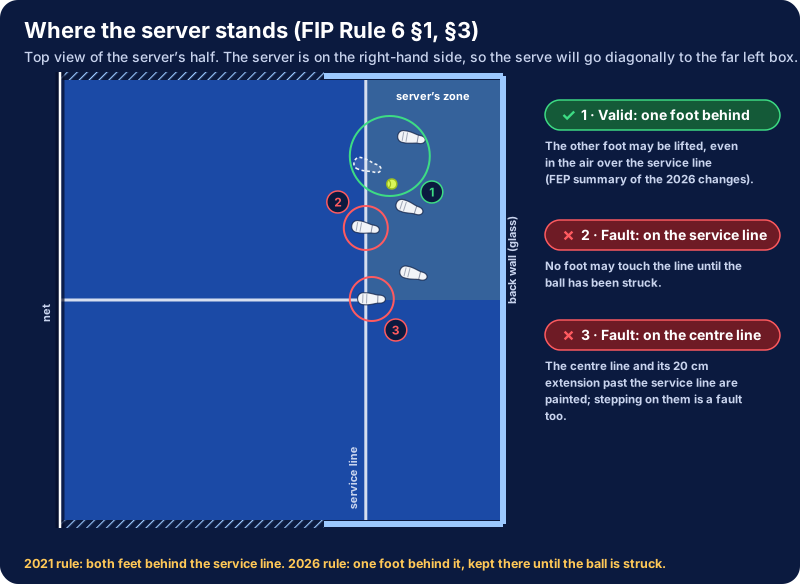
The 2021 text said the server “must be at the start of the service with both feet behind the service line” and that they “may not walk, run or jump” while serving. The 2026 text replaces both sentences. Rule 6 §1 now reads: “At the start of the service the player serving must stand with one foot behind the service line, between the imaginary prolongation of the central line of serve and the sidewall (service box) and must remain there until the ball has been served.” The Spanish federation’s summary of the changes puts it in six words: one foot in the service box, the other may invade in the air.
What stays: no foot may touch the service line or the imaginary centre line (Rule 6 §3), the ball must be at or below the waist at contact with at least one foot on the ground (§4), and a breach of any of these is a service fault (Rule 7 §1a). What changed is only the second foot: it may be lifted, and it may be in the air in front of the line, as long as the planted foot stays behind it until you have hit the ball.
The second sentence is new rather than changed. Rule 6 §2 keeps the bounce inside your own service box and adds: “The ball may not cross the service line or the imaginary line until it is struck.” A bounce that drifts forward over the line, or a ball tossed ahead and hit in front of it, is a fault even if your feet are fine. Both rules, with a diagram of each fault, are in the padel serve rules.
Two things the new text does not say, because people claim it does: it does not allow a foot on the line (touching it is still a fault, §3), and it does not say anything about jumping. The old ban on walking, running and jumping is simply gone; the one-foot-on-the-ground rule at contact (§4) is what remains.
Times: a shorter warm-up, nothing to eat or drink between points, and penalties for delay
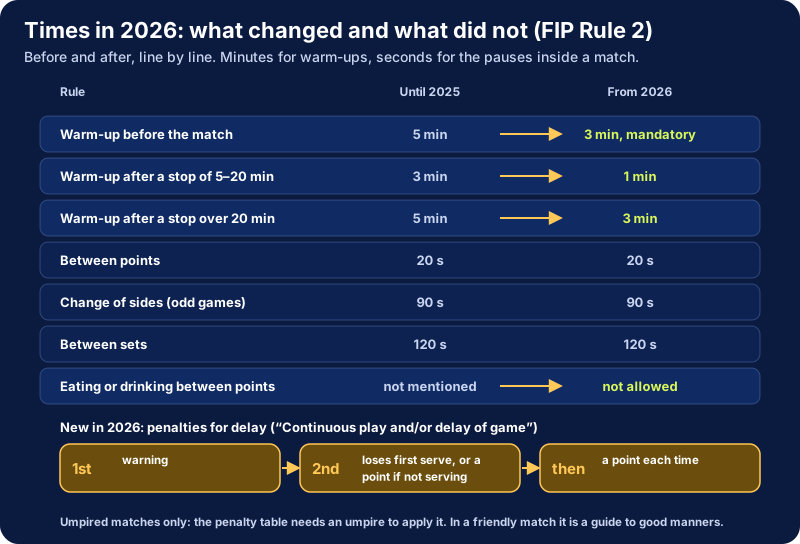
Warm-up. “There will be an obligatory 3 minutes courtesy rally between players” (Rule 2 §2); it was five minutes until 2025. The warm-up still counts as two games for the purpose of ball changes (Rule 17).
Warm-up after an interruption. When a match restarts after rain, bad light or an accident, the players are entitled to no warm-up if the stop lasted up to five minutes, one minute for a stop of 5 to 20 minutes and three minutes for a longer one (Rule 2 §11). The 2021 figures were three and five minutes.
Between points, at the changes and between sets: unchanged. Twenty seconds between points (§4), ninety seconds when changing sides at the end of a game (§5), one hundred and twenty seconds at the end of a set (§6). After the first game of a set and during a tie-break the change of sides is made without a rest.
No eating or drinking between points. New in 2026, and the sentence sits at the end of §5: “No liquids or food may be consumed between points.” Drinking is for the changes of sides and the set break. In a club match without an umpire nobody will stop you, but the rule now exists, and in a federated match it is a time violation.
The penalty ladder for slow play. The 2021 text only said that play must be continuous. The 2026 text adds a dedicated “Continuous play and/or delay of game” section with its own table:
- First violation: a warning.
- Repeat: “if the player is serving, they will lose the first serve; if they are not serving, they will lose a point.”
- Further violations: “the loss of successive points, as determined by the Referee.”
- Serious repetition or unsportsmanlike delay: additional penalties under the disciplinary code.
The FEP’s summary reads the second step as: on your first serve you lose it and play a second serve; on your second serve you lose the point; as receiver you lose the point. That interpretation is the FEP’s, not a sentence of the FIP text, but it is how Spanish umpires are being told to apply it. The time-violation count is separate from the code-of-conduct count, so a time warning does not become the first step of a conduct penalty.
A new let: an object on the floor that moves
Rule 10 lists the situations in which a point is replayed. The 2026 text adds one: “If the ball in play hits an object on the ground in the opposing field (for example, another ball) and that object moves in such a way that it could interfere with play or be dangerous to the players” (Rule 10 §1d).
Read it with Rule 14 §1f, which did not change: a ball that bounces in the opponents’ court and hits an object lying there is still a correct return. The let is only for the case where the object, typically a stray second ball, is set rolling in a way that could get in the way or hurt someone. The player who wants the let has to claim it at once, before the point continues (Rule 10 §1e); whether it was justified is the umpire’s call (§1f). Without an umpire, agree it on the spot.
Strap breaks or the racket slips: point lost
Rule 13 §1r is new: “In the event that one of the players breaks their safety cord or drops their racket, the pair will immediately lose the point in dispute.” The Spanish original says the racket “se le escape”, slips out of the hand, which covers a racket that flies off on a smash as well as one that is dropped. Until 2025 the only related text was a decision note saying a player could carry on with a broken racket unless the strap broke; that note is gone and the rule is explicit.
The strap itself is unchanged: a non-elastic wrist cord of at most 35 cm, compulsory (The racket §9). Throwing the racket at the ball was already a lost point (Rule 13 §1m).
Smaller changes you may never notice
- Interference. An involuntary interference is still a replayed point. “In the event of a second unintentional interference by the same pair, the Referee shall penalize them with the loss of the point” (Rule 11). The FEP summary does not mention this one.
- Medical time. The three-minute treatment is now “once to each player and for each treatable medical condition” (Rule 2 §15). The 15-minute allowance for accidents unrelated to play now lists examples: fainting, an allergic reaction, dizziness, a respiratory crisis (§16). And a new §17 lets the umpire give up to five minutes to recover from an unusual incident, such as a fall or a ball that hits a player during the point.
- Coaches. Coaches get their own penalty table: a warning, then expulsion from the match. Whether players may receive instructions during a medical stoppage, an outside interruption, a suspension or a toilet break is now for the umpire to decide.
- Balls. If a ball is lost or damaged, play never continues with a single ball; the replacement is a new ball if the loss happens within the first two games after a ball change and “a used ball of similar wear” afterwards (Rule 17 §e). The old fallback of replacing the whole set is gone.
- Clothing. “Players will wear suitable sports clothing and footwear. Swim wear is not allowed.” The 2021 ban on sleeveless shirts (camisetas de tirantes) is dropped. The FEP summary adds that a loose sleeveless shirt will be allowed; that clarification is the FEP’s, not in the FIP text.
- Deciding tie-breaks. The match tie-break to 7 and the super tie-break to 10 are unchanged, but the 2021 notes saying that the original service order continues into them and that no balls are changed at their start have been removed. Our tie-break guide explains how they are played in practice.
- Cases and decisions. The 2021 rulebook followed many rules with worked examples (“Case 1: … Decision: …”). All of them are gone from the 2026 text, including the one that said a lob serve that leaves the court after bouncing in the box is not a fault. The rules themselves still give the same answers; the explanations no longer do it for you.
- The court. The centre service line now extends “a minimum” of 20 cm past the service line; the advertising strip on the net band may be any colour and the band may measure 11 cm in total, where the strip alone was limited to 9 cm; the four side-wall variants are reduced to two; walls may be any single colour that does not hinder play and the floor must be one colour; the access gaps grow to a maximum of 2.20 m (single) and 1.10 m (double) wide; the safety area for out-of-court play goes from 2 m wide to 3 m, with 4 recommended; the lighting tables are replaced by a single requirement of uniform light and 1000 lux for television.
- The ball. Any colour “that has an appropriate and clear contrast with the surface color”, not only white or yellow. The altitude at which special balls may be used rises from 500 m to 1000 m; the bounce and pressure figures are unchanged.
- The racket. The holes in the 4 cm outer band may still have another shape, but now “not more than 20 mm”. Dimensions, strap and the ban on signalling devices are unchanged.
What did not change
- Sets and matches. Six games with a two-game lead, tie-break at 6-6, best of three sets, the optional third set without a tie-break, the mini-set to four, the match tie-break to 7 and the super tie-break to 10 (Rule 1).
- The tie-break. Counted 0, 1, 2; first to 7 two clear; one serve then two and two; a change of sides every six points; the next set opened by the pair that did not serve first in the tie-break (Rule 1, Tie-break; Rule 5 §2).
- Changes of sides on odd games (Rule 5 §1), and the toss with its three choices (Rule 4).
- The serve, apart from the feet and the bounce: underarm, at or below the waist, diagonal into the box, two attempts, the “net” serve replayed (Rules 6 to 9).
- The golden point. Still Option 3, unchanged in wording. Still what the Spanish federation uses in national competitions.
- Twenty seconds between points, ninety at the changes, two minutes between sets (Rule 2).
- Racket dimensions (45.5 cm overall, 26 cm wide, 38 mm thick, 35 cm strap) and the ban on any device that could signal to the player.
- Walls, fence, glass, out-of-court play (Rules 12 to 16).
Spain: what the FEP applies
The Spanish federation does not write its own rules of play. It publishes the FIP 2026 text as its Reglas del Pádel and issued a short summary of the changes in February 2026, so everything above applies on Spanish courts from the same date. The one decision that is the FEP’s own is the scoring method: its Reglamento Técnico General 2026, as amended on 13 March 2026, says in article 3.1.3 that “all national competitions are played with the ‘no advantage’ method (golden point)”. Spanish national events therefore stay on the golden point while the professional circuits play the Star Point; regional federations and private leagues choose for themselves.
The FEP summary is also where two readings come from that are not in the FIP text: the second foot “may invade in the air”, and a loose sleeveless shirt is allowed. Both are sensible glosses on a text that is silent, and both are how the rules are applied in Spain.
In a friendly match
The rules of play do not depend on who is watching. The serve, the let, the lost point for a dropped racket, the scoring options and the tie-break are the same at a club on a Saturday as in a Premier Padel final. What a friendly match cannot apply is the part of the rulebook that needs an umpire: the walkover for arriving late, the time-violation ladder, medical time, coaching restrictions.
So the practical list for four friends in 2026 is short:
- Agree the scoring method before the first serve: advantage, Star Point or golden point. The rulebook offers all three and prefers none.
- One foot behind the line is enough, but do not stand on it, and keep the bounce behind it.
- Three minutes of warm-up, and drink at the changes rather than between points, if you want to play as the pros do.
- Strap on. If it breaks or the racket flies, the point is lost.
Which English text is the official one
The FIP publishes the rules in Spanish and in an English translation. The Spanish text is the original and the FEP’s version is identical to it. Two English files have been online since December 2025: the one published on 18 December 2025, and a second upload dated 10 January 2026 that corrects a few sentences. The later file adds to Rule 6 §3 that the server may not touch the service line, the imaginary centre line “or the reception box of their own side of the court with their feet until they have hit the ball”, removes “loss of games” from the last step of the delay penalties, and allows the Star Point to carry a sponsor’s name. The Spanish text matches the December wording. Where the two English files differ, this page follows the Spanish original and says so.
The English translation also has a few slips that the Spanish does not: Option 3 §2 says the golden point wins “the match” (the original says the game), and the mesh height of side-wall variant 1 is given for “the center 6 meters” instead of 16. None of them changes a rule.
Sources
All rule statements on this page were checked against the official texts below on 9 October 2026.
- FIP, Rules of Padel, revision applying from 01.01.2026, first English upload of 18 December 2025: padelfip.com/…/FIP_Rules-of-Padel.pdf; corrected English upload of 10 January 2026: padelfip.com/…/FIP_Rules-of-Padel-1.pdf. Spanish original, Reglas del Pádel: padelfip.com/…/FIP_Reglas-del-Padel.pdf. If the FIP link moves, we keep a reduced-size copy of the Spanish text as downloaded on 7 October 2026; the FIP site is the authoritative version. Rules cited: The court, The ball, The racket, Attire; Rule 1 (Score in a game), Rule 2 (Times), Rule 4, Rule 5, Rule 6 (The serve), Rule 7, Rule 10 (Let), Rule 11 (Interference), Rule 13 (Point lost), Rule 14, Rule 17 (Change of balls), Continuous play and/or delay of game, Penalties tables.
- FIP, Reglamento de Juego del Pádel, revision applying from 28.05.2021, the previous text, compared in full with the 2026 Spanish text to build the change table. Federation mirror: fmpadel.com/docs/FIP-Reglamento-Juego.pdf.
- FIP, 29 November 2025, “35th FIP General Assembly concludes in Acapulco”: padelfip.com. FIP press release, 18 December 2025, “Between innovation and tradition: introducing the Star Point”: English · Spanish PDF. Approval date, circuits and first events.
- Federación Española de Pádel, 2026 – Reglamento de juego, summary of the FIP changes: padelfederacion.es/…/Resumen-cambios-reglamento-FIP.pdf. The FEP publishes the FIP 2026 rules as its rules of play: padelfederacion.es/…/FIP_Reglas-del-Padel-1.pdf.
- Federación Española de Pádel, Reglamento Técnico General 2026 (amendments approved on 13 March 2026), article 3.1.3: padelfederacion.es/…/RTG CD 13-3-26.pdf.
- The diagrams on this page are our own drawings. They illustrate the rule text; where a drawing and the text could be read differently, the text applies.
Frequently asked questions
What are the new padel rules in 2026?
The FIP rulebook that applies from 1 January 2026 adds the Star Point as a scoring option (two advantages, then one deciding point), lets the server keep only one foot behind the service line, forbids the bounced ball from crossing the line before it is hit, cuts the warm-up to three minutes, bans eating and drinking between points, adds a penalty ladder for delays, a new let for objects on the floor that move, and an immediate point loss when the strap breaks or the racket slips out of the hand. Several smaller changes cover interference, medical time, coaches, ball changes, clothing and the court.
Since when do the 2026 padel rules apply?
From 1 January 2026. The revision was approved by the FIP General Assembly in Acapulco on 28 November 2025 and published on 18 December 2025. The professional circuits used it from their first events of 2026, and the Spanish federation publishes the same text as its rules of play.
Can you serve with one foot inside the court in padel now?
Rule 6 §1 of the FIP 2026 text requires only one foot behind the service line at the moment you start the stroke; the Spanish federation’s summary adds that the other foot may be in the air, even over the line. Neither foot may touch the service line nor the imaginary centre line, and you have to stay behind the line until you have hit the ball (Rule 6 §3). The ball must also be at or below your waist when you hit it (Rule 6 §4).
How long is the warm-up before a padel match now?
Three minutes, and it is compulsory (FIP Rule 2 §2). Until 2025 it was five. After an interruption the warm-up is one minute if the stop lasted between 5 and 20 minutes, and three minutes if it lasted longer (Rule 2 §11).
Can you drink water between points in padel?
Not under the 2026 rules: “no liquids or food may be consumed between points” (FIP Rule 2 §5). You drink at the changes of sides, which allow 90 seconds, and at the end of a set, which allows 120 seconds. In a friendly match without an umpire nobody will penalise you, but that is the rule.
Does the golden point disappear in 2026?
No. The golden point stays in the rulebook as Option 3 of Rule 1, after advantage (Option 1) and the new Star Point (Option 2). Every competition picks one of the three. In Spain the FEP’s technical regulations keep the golden point for all national competitions in 2026.
Do the new rules apply to friendly matches?
The rules of the game do, whoever is playing: the serve, the let, the lost point for a dropped racket, the scoring options. What you cannot apply without an umpire is the disciplinary part, such as the time penalties or the walkover. In a friendly match agree the scoring method before you start and play the rest as written.
Keep the real score, live.
Pair your remote and let PadelRef call the score for you.