Star Point in padel: how the 2026 scoring rule works

Rules version: this article follows the FIP Rules of Padel, revision applying from 1 January 2026 (approved in Acapulco on 28 November 2025). Published 7 October 2026 · last checked 7 October 2026. We re-read the FIP and FEP texts whenever they change and update this page; the sources are listed at the end.
The Star Point is the new way to finish a game that reaches 40-40 (deuce), in force on the professional circuits since 2026. It sits between the two systems padel already had: the classic advantage, which can go on forever, and the golden point, which ends the game on one shot. With Star Point you get at most two advantages; if the game is still level after that, one deciding point settles it.
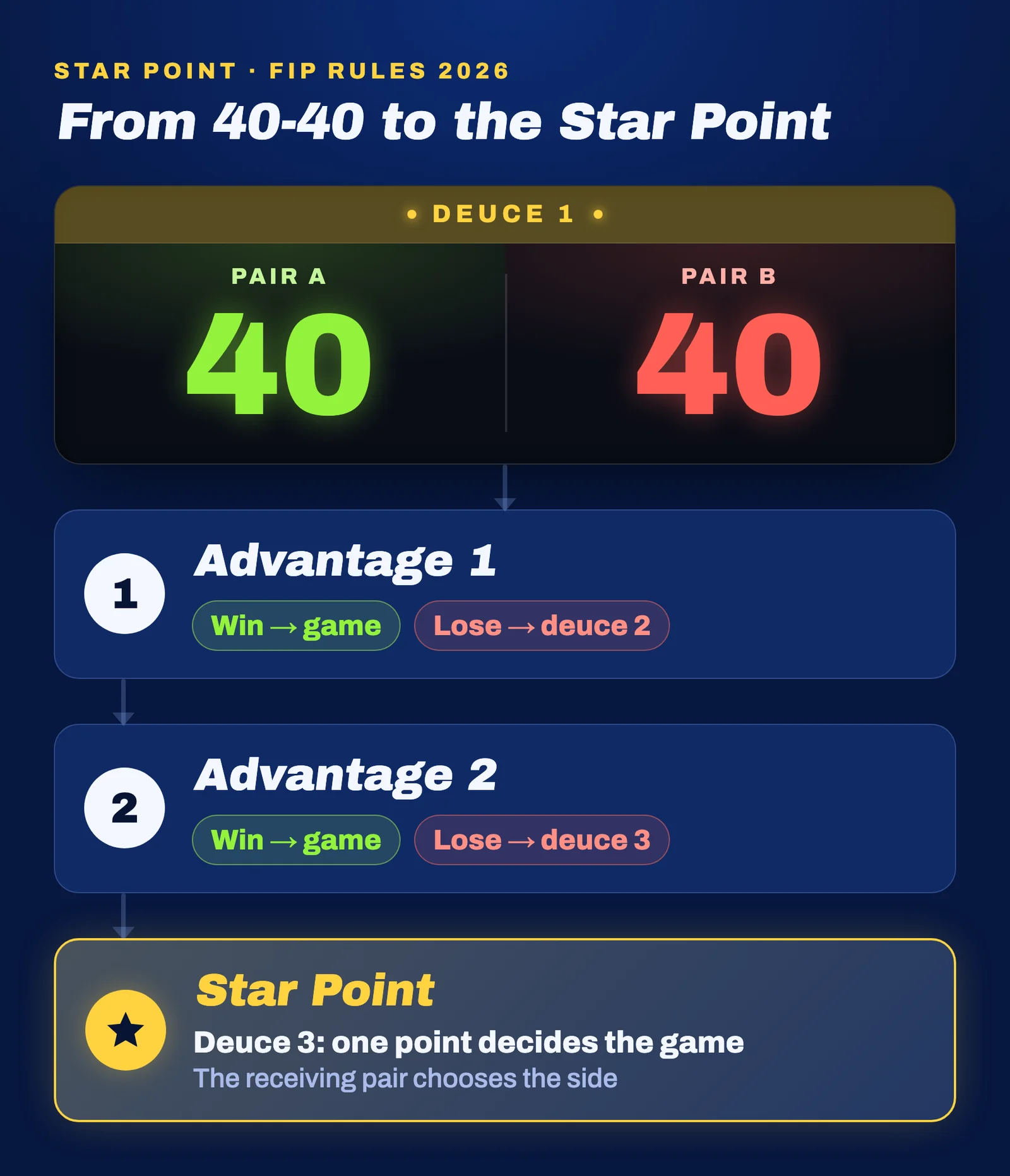
Star Point in 20 seconds
At 40-40 the umpire calls “deuce 1”. Win the next point and you have “advantage 1”; win again and the game is yours, lose and it is “deuce 2”. The same happens once more: “advantage 2”, then either game or “deuce 3”. At deuce 3 a single Star Point is played. The receiving pair chooses whether to receive on the right or the left, the partners cannot swap positions, and whoever wins that point wins the game.
| Score | Called (FIP, English) | Called (FIP, Spanish) | Then |
|---|---|---|---|
| 40-40 | deuce 1 | iguales 1 | next point gives advantage 1 |
| advantage 1 | advantage 1 | ventaja 1 | win → game · lose → deuce 2 |
| level again | deuce 2 | iguales 2 | next point gives advantage 2 |
| advantage 2 | advantage 2 | ventaja 2 | win → game · lose → deuce 3 |
| level again | deuce 3 · Star Point | iguales 3 · Star Point | one point decides the game |
That is the whole rule. A game can no longer run through five, eight or twelve deuces: after the third deuce it is over on the next point.
How a Star Point game plays out
Take a game that reaches 40-40.
- Deuce 1. Pair A wins the point: advantage 1, A.
- Pair B wins the next one: back to deuce 2.
- Pair B wins again: advantage 2, B.
- Pair A saves it: deuce 3, and the umpire announces the Star Point.
- The receiving pair says which side they want to receive on. One point is played. Whoever wins it wins the game.
Counting the whole game from 0-0, a Star Point game is at most 11 points long: six to reach the first deuce and up to five more. A golden-point game cannot exceed seven points, and an advantage game has no limit at all. That cap is the reason the rule exists.
Who receives the Star Point
The deciding point is served like any other point, but the receiving pair picks the side it will receive on: right or left. Two details trip people up:
- The receivers cannot swap positions. The pair chooses a side, not a player. Whoever normally plays that side receives there.
- In mixed doubles, the receiver is the player of the same sex as the server. The receiving pair still cannot change positions.
Both points are written into the rule itself, in the same words FIP uses for the golden point. If you already play golden point, nothing changes here: the Star Point is simply a golden point that is only reached after two advantages have come and gone.
Why FIP introduced the Star Point
Padel has argued about deuce for years. The World Padel Tour played with golden point from the 2020 season: one deciding point at 40-40, and the receivers choose the side. When Premier Padel took over the top of the sport it went back to the classic advantage system, which the FIP Tour’s smaller events did not use. Two professional circuits, two ways to count the same score.
The long-advantage games were the problem that would not go away. In a close match a single game can go through deuce after deuce, players arrive at the next round more tired, and nobody watching on television can be told when the match will end. The FIP spent the 2025 season consulting players, coaches, promoters, broadcasters and commercial partners, says every group came back in favour, and took the proposal through the Premier Padel Steering Committees. The FIP General Assembly approved the Star Point unanimously on 28 November 2025, with 100 national federations represented, and it entered the rulebook as Rule 1, Option 2, in the revision that applies from 1 January 2026.
The federation’s own description of the aim is short: the rule “limits the maximum number of points that can be played in a game, avoiding prolonged advantage situations”, and it balances “the essence of the game with its evolution, improving athlete welfare and boosting audience engagement”. Luigi Carraro, the FIP president, put it this way when the 2026 Premier Padel calendar was announced: “Designed to preserve padel tradition, whilst improving player welfare and broadcast predictability, this move also aligns with International Olympic Committee objectives around sport innovation and fan-driven adaptations.”
So the Star Point is a compromise. The advantage system kept its two chances to close a game from deuce, which the traditionalists wanted. The golden point’s hard stop stays, which the broadcasters and the players’ bodies wanted. The compromise is also what makes it a little more work to follow.
Why it is harder to follow than the old rules
Neither old system asked anyone to count. With advantage, you only needed to know who had it. With golden point, 40-40 meant one point and done. The Star Point adds a small bookkeeping job that did not exist before:
- You have to count deuces. Deuce 1, deuce 2 and deuce 3 are different scores, and so are advantage 1 and advantage 2. The calls carry a number for exactly this reason. Miss one and the pairs will disagree about whether the next point is “just” an advantage or the game.
- Three systems now coexist in the same rulebook. FIP Rule 1 lists advantage as Option 1, Star Point as Option 2 and golden point as Option 3. None of them is “the” rule; the competition decides. The same players can be on golden point in a national league on Saturday and on Star Point in an international event the next week.
- The receiver’s choice happens only once, at deuce 3. Under golden point the choice comes at every 40-40, so players are used to making it immediately. Under Star Point it is easy to forget that the choice exists at all, because two deuces have already gone by without it.
- Scoreboards and announcers need new states. “Advantage” is no longer one state but two, and “deuce” is three. Anything that calls or displays the score, from a club scoreboard to a scoring app, has to know which deuce it is.
None of this is difficult once you have played a few games under it. It is simply more to keep in your head than either of the systems it replaces on the pro tour.
Advantage, Star Point and golden point side by side
| Advantage (Option 1) | Star Point (Option 2) | Golden point (Option 3) | |
|---|---|---|---|
| What happens at 40-40 | Win two points in a row to take the game | Up to two advantages, then one deciding point | One deciding point |
| Maximum deuces | Unlimited | Three | One |
| Receivers choose the side | No | Yes, on the Star Point only | Yes, on every golden point |
| Receivers may swap positions | n/a | No | No |
| Mixed: who receives the deciding point | n/a | The player of the same sex as the server | The player of the same sex as the server |
| Longest possible game | No limit | 11 points | 7 points |
| Who played it in 2026 | Many club and friendly matches | Premier Padel, CUPRA FIP Tour, FIP Promises, FIP Beyond | FEP national competitions in Spain; many amateur leagues |
Where the Star Point is played in 2026
Professional and FIP circuits. From the 2026 season the Star Point is used in Premier Padel, the CUPRA FIP Tour, FIP Promises and the amateur FIP Beyond circuit. It was first used at the FIP Bronze Melbourne (5 to 11 January 2026), the opening stop of the CUPRA FIP Tour, and made its Premier Padel debut at the Riyadh Season P1 (9 to 14 February 2026).
Spain. The Spanish federation (FEP) publishes the 2026 FIP rules as its own rules of play, so the Star Point is a legal option on Spanish courts. But the FEP’s general technical regulations for 2026 say that all national competitions are played with the “no advantage” method, the golden point (article 3.1.3). If you play FEP-sanctioned national events, expect golden point, not Star Point. Regional federations, private leagues and clubs set their own format, so check the regulations of the competition you are entering.
Everywhere else. Other national federations choose among the three options for their own competitions. The rulebook does not make the Star Point mandatory anywhere; it makes it available.
Agreeing the system in a friendly match
In a match with no umpire, the only rule that matters is the one all four players agreed on before the first serve. Three habits avoid most 40-40 arguments:
- Say it out loud before you start: “advantage”, “Star Point” or “golden point”. Do not assume the other pair plays what you play.
- Have the server call the full score, number included, at every deuce and advantage: “deuce 2”, “advantage 1”. The number is part of the score.
- At deuce 3, the receivers choose the side before the server bounces the ball. Decide quickly and do not swap.
If you want shorter games but find the golden point too brutal, the Star Point is the format to try. If your group has always played advantage and enjoys the long games, nothing in the 2026 rules forces you to change.
Frequently asked questions
What is the Star Point in padel?
A way of finishing a game that reaches 40-40, introduced by the International Padel Federation for 2026. The pairs play with advantage up to two times; if the game is still level after the second advantage is lost, a single deciding point, the Star Point, is played and whoever wins it wins the game.
How many advantages are there before the Star Point?
Two. The sequence is deuce 1, advantage 1, deuce 2, advantage 2, deuce 3 and then the Star Point. A pair that converts either advantage wins the game before the Star Point is reached.
Who chooses the side on the Star Point?
The receiving pair chooses whether to receive on the right or the left side of the court. The two receivers cannot change positions for that point. In mixed doubles the player of the same sex as the server receives.
Is the Star Point mandatory in 2026?
No. FIP Rule 1 offers three options: advantage, Star Point and golden point. The Star Point is used on the professional and FIP circuits from 2026; every other competition chooses its own option. Friendly matches can play whichever system the four players agree on.
Is the Star Point used in Spanish federation competitions?
Not in the national ones. The Spanish federation’s 2026 general technical regulations (article 3.1.3) state that all national competitions are played with the golden point. Regional and club competitions may differ, so read the competition’s rules.
What is the difference between the Star Point and the golden point?
The golden point is played at the first 40-40. The Star Point is only played at the third deuce, after two advantages have been won and then lost. The deciding point itself is identical: the receivers choose the side, cannot swap positions, and the winner takes the game.
Does the Star Point replace the golden point?
No. The golden point stays in the rulebook as Option 3 and is still the format of many leagues, including the Spanish federation’s national competitions. The Star Point was added as Option 2; it did not remove anything.
Sources
All rule statements on this page were checked against the official texts below on 7 October 2026.
- FIP, Rules of Padel, revision applying from 01.01.2026, Rule 1 “Score in a game”, Option 2 “Star Point” (English): padelfip.com/…/FIP_Rules-of-Padel.pdf. Spanish original, Reglas del Pádel, Regla 1, Método 2: padelfip.com/…/FIP_Reglas-del-Padel.pdf. If the FIP link moves, we keep a reduced-size copy of the Spanish text as downloaded on 7 October 2026; the FIP site is the authoritative version.
- FIP press release, 18 December 2025, “Between innovation and tradition: introducing the Star Point”: English · Spanish PDF. Approval date, circuits and first events.
- FIP and Premier Padel, 18 December 2025, “2026 Qatar Airways Premier Padel Tour calendar and innovative new Star Point system launched”: padelfip.com. Consultation process and the Luigi Carraro quote.
- Federación Española de Pádel, Reglamento Técnico General 2026 (amendments approved on 13 March 2026), article 3.1.3: padelfederacion.es/…/RTG CD 13-3-26.pdf. The FEP also publishes the FIP 2026 rules as its rules of play: padelfederacion.es/…/FIP_Reglas-del-Padel-1.pdf, and a summary of the 2026 changes: Resumen-cambios-reglamento-FIP.pdf.
- For the history of the golden point on the World Padel Tour (introduced for the 2020 season): Almonacid et al., “Influence of the play score on external load parameters in men’s and women’s professional padel”, Cultura, Ciencia y Deporte 18(56), 2023: ccd.ucam.edu.
Keep the real score, live.
Pair your remote and let PadelRef call the score for you.