Who serves in padel? First serve, second set and tie-break

Rules version: this article follows the FIP Rules of Padel, revision applying from 1 January 2026 (approved in Acapulco on 28 November 2025), which the Spanish federation (FEP) also publishes as its own rules of play. Published 9 October 2026 · last checked 9 October 2026. We re-read the FIP and FEP texts whenever they change and update this page; the sources are listed at the end.
“Whose serve is it?” is asked on every padel court, at the start of the match, at the start of the second set and, most of all, after a tie-break. The rulebook answers most of it in four paragraphs that few players have read, and leaves one case, the ordinary second set, to a convention padel borrowed from tennis. This page goes through every situation in order, says which is a rule and which is practice, and ends with what happens when somebody gets it wrong.
The short answer: a toss decides who serves the first game. After that the pairs alternate service games, and inside each pair the partners take turns; the order is fixed for the set. A new set continues the alternation, and each pair may choose again which partner starts. In a tie-break the player whose turn it is serves one point, then everyone serves two; the set after a tie-break is opened by the pair that did not serve its first point.
The toss: serve, receive or choose the end
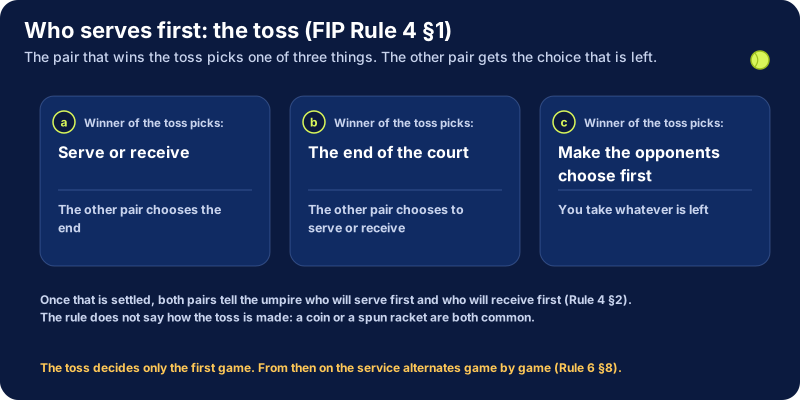
Rule 4 §1: “The choice of ends or sides, who serves first and who receives should be decided by the flip of a coin. The pair who wins the toss may choose between: a) Serving or receiving first. In which case the other pair will choose the side. b) Side of the court for the first game. In which case the other pair may choose to serve or receive. c) Request that the opponents choose first.”
Three points of detail:
- The winner picks one thing, not two. If you choose to serve, the other pair chooses the end. If you want the end with the sun behind you, the other pair decides who serves. Option c) hands the first choice over and leaves you with what remains, which is sometimes the better deal.
- “Coin toss” is the English translation, but the Spanish rules actually say sorteo, which simply means a draw. In official FIP matches, the umpire flips a coin before the warm-up, with both pairs watching, and announces who won and what they chose. In casual club matches, players usually spin a racket and call the grip cap or logo, or play a quick point (bola de saque) to decide who serves first. All of these are perfectly valid ways to do the draw.
- Then tell the umpire. “Once the order of serve and the ends have been decided, both pairs tell the umpire who will be the first to serve and receive” (Rule 4 §2). Without an umpire, say it to the other pair, so that nobody has to reconstruct it at 5-4.
The toss decides only the first game. From then on the order is mechanical.
The order inside each pair, game by game
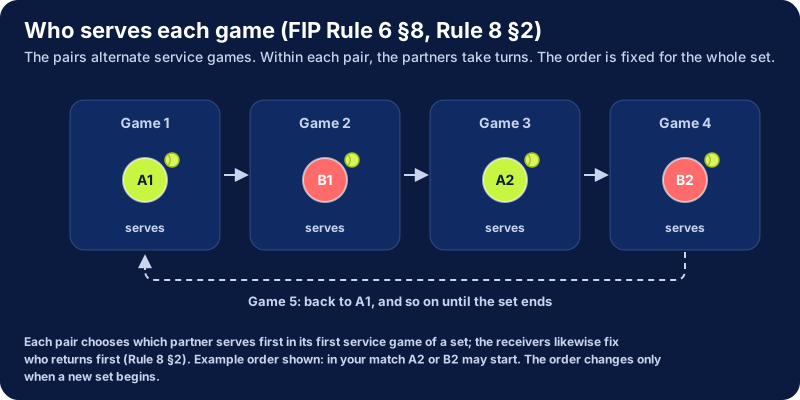
The Spanish text of Rule 6 §8 is the fullest statement of the rotation: the pair with the right to serve in the first game of each set decides which of its players starts; when that game ends the pair that was receiving serves, choosing its player, “and so on alternately during all the games of a set. Once the order of service has been established, it cannot be altered until the start of the following set.” The English translation keeps only the last part, “before starting each set the players may choose which one of them will serve first during the set. Once the order has been established it may not be changed until the beginning of the following set”, so if you ever argue the point from the English PDF, the alternation between pairs is in the Spanish original.
The resulting sequence has four slots and repeats every four games: A1, B1, A2, B2, A1… A serves game 1, B game 2, A’s other player game 3, B’s other player game 4, and round again. Game 5 belongs to the player who served game 1, game 9 and game 13 likewise.
The receivers are fixed in the same way. “The receiving players in first game of each set will decide who will be the first to receive; this player will continue receiving the first service of each game until the end of the set” (Rule 8 §2). Since the first serve of every game is struck from the server’s right and lands in the box diagonally opposite, the player chosen to receive first is, in effect, the receiver on that side for the whole set, and “once the order has been decided it may not be altered during that set or tie-break but may at the beginning of a new set” (Rule 8 §3). What the receivers do between points, moving to the net or switching after the return, is their business; the rule fixes only who takes the serve on which side.
Who serves in the second set
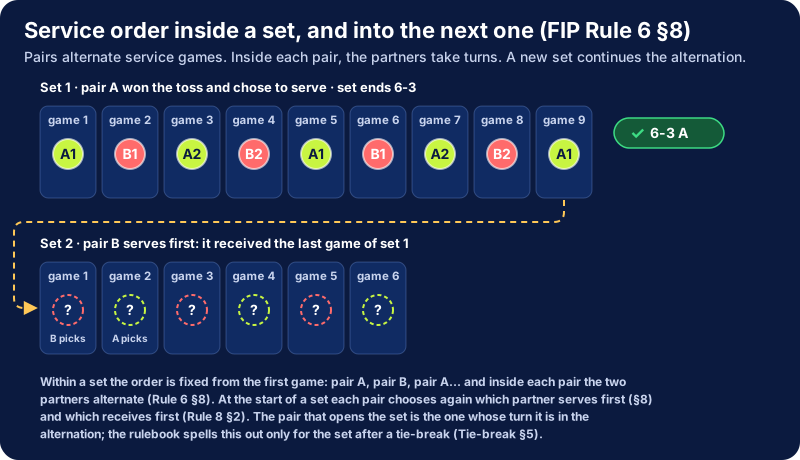
Here the rulebook is quieter than players expect. Rule 6 §8 fixes the alternation “during all the games of a set” and lets each pair re-choose its first server “before starting each set”. The tie-break section says who opens the set after a tie-break. No sentence says who serves the first game of the second set after a set that ended 6-3 or 6-4.
The answer everyone applies, umpires included, is that the alternation does not restart: the pair that received the last game of the previous set serves the first game of the new one. This is the rule in tennis, whose Rule 14 says that “at the end of each standard game, the receiver shall become the server”, with no exception at the end of a set, and padel’s Rule 6 §8 and Rule 8 §2 are near-literal copies of tennis Rules 14 and 15. It is also the only reading under which the tie-break rule makes sense: Tie-break §5 is just the ordinary alternation applied to a thirteenth game.
Two consequences:
- Count the games, not the sets. The pair that served the first game of a set serves every odd game of it. After a set with an odd number of games (6-3 is nine, 7-6 is thirteen) that pair also served the last game, so the other pair opens the next set. After an even number of games (6-4, 6-2, 7-5) the same pair opens the next set too. A rule of thumb repeated on some sites, “the pair that served first in set one serves first in set two”, is therefore true only after an even number of games.
- The pair is fixed; the player is not. Whichever pair opens the set chooses again which partner serves first (Rule 6 §8), and the receiving pair chooses again who receives first (Rule 8 §2). A pair that opened the first set with its weaker server may open the second with its stronger one.
If the players cannot agree and there is no umpire, the fair tie-breaker is the one the rulebook uses after a tie-break: the pair that did not serve the last game serves the next.
Who serves in the tie-break
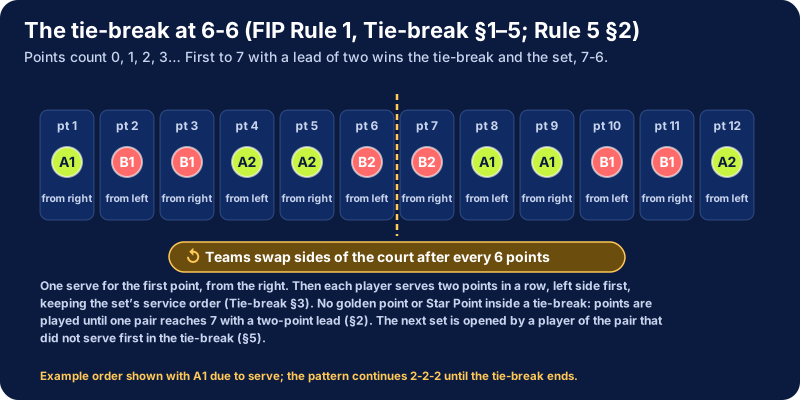
The tie-break “will be started by the player whose turn it is to serve according to the order followed in the set”, who serves one point from the right. “The following two points will be served by the players of the opposite team respecting the previous order of service and serving from the left. After this the players will serve two consecutive points until the end of the tiebreak always respecting the order of service” (Rule 1, Tie-break §3).
Nobody chooses who starts a tie-break. It is game thirteen, and in a four-player rotation games 1, 5, 9 and 13 belong to the same player: if nobody has served out of turn, the tie-break is opened by whoever served the first game of the set. The 2021 rulebook said this in so many words, in a worked example that the 2026 text no longer prints; the arithmetic has not changed. The receiving order stays as it was in the set (Rule 8 §3). Points, the change of sides every six points and the formats to 7 and 10 are in our padel tie-break rules.
Who serves after the tie-break
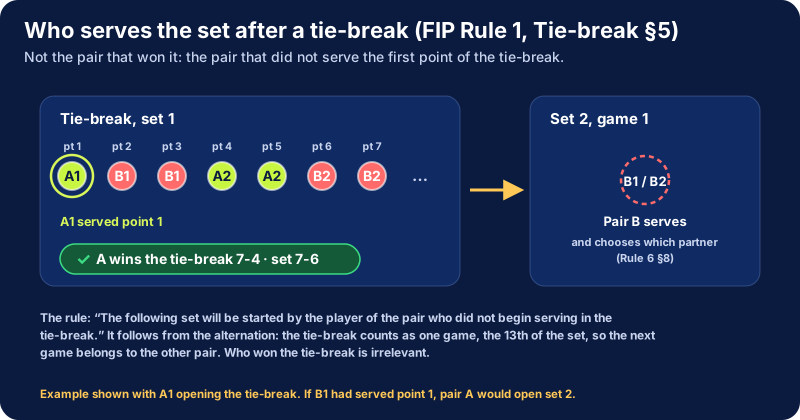
“The following set will be started by the player of the pair who did not begin serving in the ‘tie-break’” (Tie-break §5). The Spanish original says un jugador de la pareja, a player of the pair: the pair is fixed by the rule, the player is the pair’s choice under Rule 6 §8.
The common mistake is to give the serve to the pair that won the tie-break, or to the player who served its first point “because it’s their turn again”. Neither is right. The tie-break was one game, served first by pair A, so the next game belongs to pair B, whatever the score. Tennis states the same thing from the receiver’s side: the player who served first in the tie-break receives first in the next set.
If the tie-break was a match tie-break or a super tie-break played instead of a third set, there is no next set.
The deciding point: the receivers choose the side
One more “who” that catches people out. In every ordinary point the server serves from the right first and then alternates. On a deciding point, the golden point at 40-40 or the Star Point at the third deuce, “the receiving pair will choose whether to receive the service on the right or the left side of the court. The players of the receiving pair cannot change positions to receive the deciding point” (Rule 1, Option 2 §1 and Option 3 §2). So the receivers say which side the serve goes to, but whoever normally plays that side takes it. In mixed doubles “the player receiving will be the same sex as the server” (Option 2 §2, Option 3 §3). The server does not change: it is still the player whose game it is.
How the three deciding-point systems work, and where each is played in 2026, is in how padel scoring works and the guide to the Star Point.
Serving out of turn, from the wrong box, or receiving in the wrong order
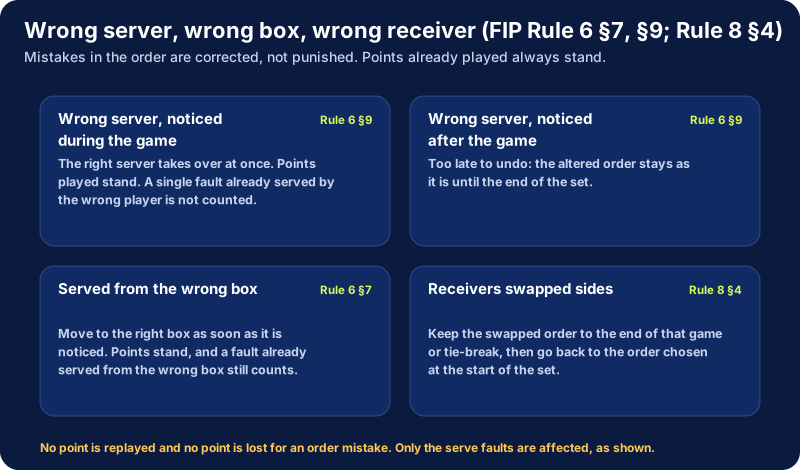
Mistakes in the order are corrected, not punished, and the points already played always stand. The details differ by mistake, and the treatment of a fault already served is the part worth knowing:
- Wrong server, noticed during the game. “The player who should have served must do so as soon as the error is discovered. All points won before the error are valid. If there has been a single service fault up to the time of the error it will not be taken into account” (Rule 6 §9). The right server starts with two serves.
- Wrong server, noticed after the game. “In the case that the game has finished before the error is discovered the order of serve will remain as is until the conclusion of the set” (§9). You do not go back.
- Served from the wrong box. “The error will have to be corrected as soon as is discovered. All points are valid, but a fault on the first service must be taken into account” (Rule 6 §7). Here the fault does count: the server moves to the correct box with one serve left.
- Receivers in the wrong order. “They will have to continue in this manner until the end of the game or tie-break in which the mistake occurred. In the following games of that set, the players will adopt the positions initially selected” (Rule 8 §4).
- Forgot to swap sides. Correct it as soon as it is noticed; points stand; if a first-serve fault has already been served, only one serve remains (Rule 5 §3).
Tennis has a further rule for a wrong server discovered in the middle of a tie-break, depending on whether an odd or even number of points has been played. Padel’s text has no such clause; Rule 6 §9 applies as written, and the right server takes over at once.
After an interruption
If a match is stopped for rain, light or an accident and resumed later, “the match will begin exactly where it ended before it was suspended. With regard to: the game, score, player to serve, same place on the court and same order of serve and return” (Rule 2 §12). Nobody re-tosses and nobody re-chooses. Write the score and the server down before you leave the court.
Match tie-break and super tie-break
When a match tie-break to 7 or a super tie-break to 10 replaces the third set, the 2026 rulebook says nothing about who serves first in it. The 2021 text had a note, since removed, saying that the original service order continued and that each pair could reorder its server and receiver for it. In practice that is still how it is played: the deciding tie-break is treated as the first game of a third set, so the pair that did not serve the last game of the second set opens it, with the usual one-then-two-and-two pattern. Agree it before the match if you play this format.
Who serves, situation by situation
| Situation | Who serves | Rule |
|---|---|---|
| First game of the match | Decided by the toss; the winner chooses to serve, to receive, the end, or to let the opponents choose | Rule 4 §1 |
| Games 2, 3, 4… of a set | The pairs alternate; inside each pair the partners alternate; fixed for the set | Rule 6 §8 |
| First game of the next set | The pair that received the last game of the previous set; it chooses which partner | Rule 6 §8 (practice; stated by the rulebook for the post-tie-break case only) |
| Tie-break, point 1 | The player whose turn it is, one point from the right | Tie-break §3 |
| Tie-break, points 2 and 3, then two each | The other pair from the left, then two consecutive points per player in the set’s order | Tie-break §3 |
| Set after a tie-break | A player of the pair that did not serve the first point of the tie-break | Tie-break §5 |
| Deciding point (golden point, Star Point) | The same server; the receivers choose the side and may not swap | Rule 1, Options 2 and 3 |
| After a suspension | The same player as when play stopped | Rule 2 §12 |
| Wrong server noticed mid-game | The right player, immediately; points stand; a single fault is wiped | Rule 6 §9 |
Sources
All rule statements on this page were checked against the official texts below on 9 October 2026.
- FIP, Rules of Padel, revision applying from 01.01.2026: Rule 1 “Score in a game” (Option 2 §1 and §2, Option 3 §2 and §3, “Tie-break” §3 and §5), Rule 2 “Times” §12, Rule 4 “Choice of sides and service”, Rule 5 §3, Rule 6 “The serve” §5, §7, §8 and §9, Rule 8 “Return of serve” §2 to §4 (English): padelfip.com/…/FIP_Rules-of-Padel.pdf. Spanish original, Reglas del Pádel, Regla 1, Regla 2 §12, Regla 4, Regla 5 §3, Regla 6 §5, §7, §8 y §9, Regla 8 §2 a §4: padelfip.com/…/FIP_Reglas-del-Padel.pdf. The Spanish Regla 6 §8 contains the pair-by-pair alternation that the English §8 omits. If the FIP link moves, we keep a reduced-size copy of the Spanish text as downloaded on 7 October 2026; the FIP site is the authoritative version.
- FIP, Reglamento de Juego del Pádel, revision applying from 28.05.2021: the “Caso 1” under the tie-break (the player who began serving the set opens the tie-break) and “Nota 1” under the alternative scoring methods (service order in a deciding tie-break), both absent from the 2026 text. Federation mirror: fmpadel.com/docs/FIP-Reglamento-Juego.pdf.
- FIP, Duties and Procedures for FIP Officials, 23 January 2026, chair umpire’s duties (the coin toss before the warm-up, the announcement of the toss, the order of service on the scorecard): padelusa.org/…/DUTIES-AND-PROCEDURES-FOR-OFFICIALS-FIP-23_01_2026.pdf.
- ITF, Rules of Tennis, Rule 9 “Choice of ends and service”, Rule 14 “Order of service”, Rule 15 “Order of receiving in doubles”, Rule 5 (tie-break game) and Rule 27 “Correcting errors”, used only for the comparison with tennis: itftennis.com.
- The FEP publishes the FIP 2026 rules as its rules of play: padelfederacion.es/…/FIP_Reglas-del-Padel-1.pdf.
- The diagrams on this page are our own drawings. They illustrate the rule text; where a drawing and the text could be read differently, the text applies.
Frequently asked questions
How is it decided who serves first in padel?
By a toss before the match (FIP Rule 4 §1). The pair that wins it chooses one of three things: to serve or to receive, in which case the other pair picks the end; the end, in which case the other pair picks serve or receive; or to make the opponents choose first. The English rulebook says a coin; at club level a spun racket or a point played for the serve are common and equally valid, because the rule only requires a draw.
Who serves in the second set in padel?
The alternation between the pairs simply carries on: the pair that received the last game of the first set serves the first game of the second. The FIP text states this only for the set after a tie-break (Rule 1, Tie-break §5); for a set that ended 6-3 or 6-4 it is the universal practice, and the tennis rule from which the padel rule is copied. Each pair then chooses again which partner serves first (Rule 6 §8).
Can you change the serving order in padel?
Only at the start of a set. Each pair decides which partner serves first in its first service game of a set, and “once the order has been established it may not be changed until the beginning of the following set” (FIP Rule 6 §8). The same applies to who receives first (Rule 8 §2 and §3). A tie-break is part of the set, so the order does not change for it either.
Who serves first in a padel tie-break?
The player whose turn it is in the set’s rotation, as if the tie-break were the thirteenth game. That player serves one point from the right; the other pair then serves two points, starting from the left, and from there every player serves two points in turn (Rule 1, Tie-break §3). If nobody has served out of turn, it is the player who served the first game of the set.
Who serves after a tie-break in padel?
A player of the pair that did not serve the first point of the tie-break (Rule 1, Tie-break §5), whoever won it. That pair chooses which of its two players serves, as every pair does at the start of a set (Rule 6 §8).
What happens if the wrong player serves in padel?
The right player takes over as soon as the mistake is noticed. The points already played stand, and a single fault served by the wrong player is not counted. If the game had already finished when the mistake was noticed, the altered order stays until the end of the set (FIP Rule 6 §9). No point is lost or replayed.
Keep the real score, live.
Pair your remote and let PadelRef call the score for you.